
Scripture
What is the fruit of the Spirit?
Nine words in Galatians 5 describe what the Spirit grows in a believer, not what a believer performs for God.
When someone names the fruit of the Spirit, they usually mean love, joy, peace, and the rest as a list of virtues to go chase.
That is not how Paul hands it to us.
He hands it to us inside a fight. Galatians 5 is about two forces pulling in opposite directions inside every believer, and the fruit is what grows on one side of that fight, not a checklist for the other.
This I say then, Walk in the Spirit, and ye shall not fulfil the lust of the flesh. For the flesh lusteth against the Spirit, and the Spirit against the flesh: and these are contrary the one to the other: so that ye cannot do the things that ye would.
That is the setup. Two natures, pulling against each other. What follows in the chapter is the evidence of each one.
What does the flesh produce?
Paul lists it first, and he does not soften it.
Now the works of the flesh are manifest, which are these; Adultery, fornication, uncleanness, lasciviousness, Idolatry, witchcraft, hatred, variance, emulations, wrath, strife, seditions, heresies, Envyings, murders, drunkenness, revellings, and such like: of the which I tell you before, as I have also told you in time past, that they which do such things shall not inherit the kingdom of God.
Seventeen words for one source. The flesh does not need help. It produces on its own, the way a weed produces on its own, with no one tending it.
Then Paul turns the page.
But the fruit of the Spirit is love, joy, peace, longsuffering, gentleness, goodness, faith, Meekness, temperance: against such there is no law.
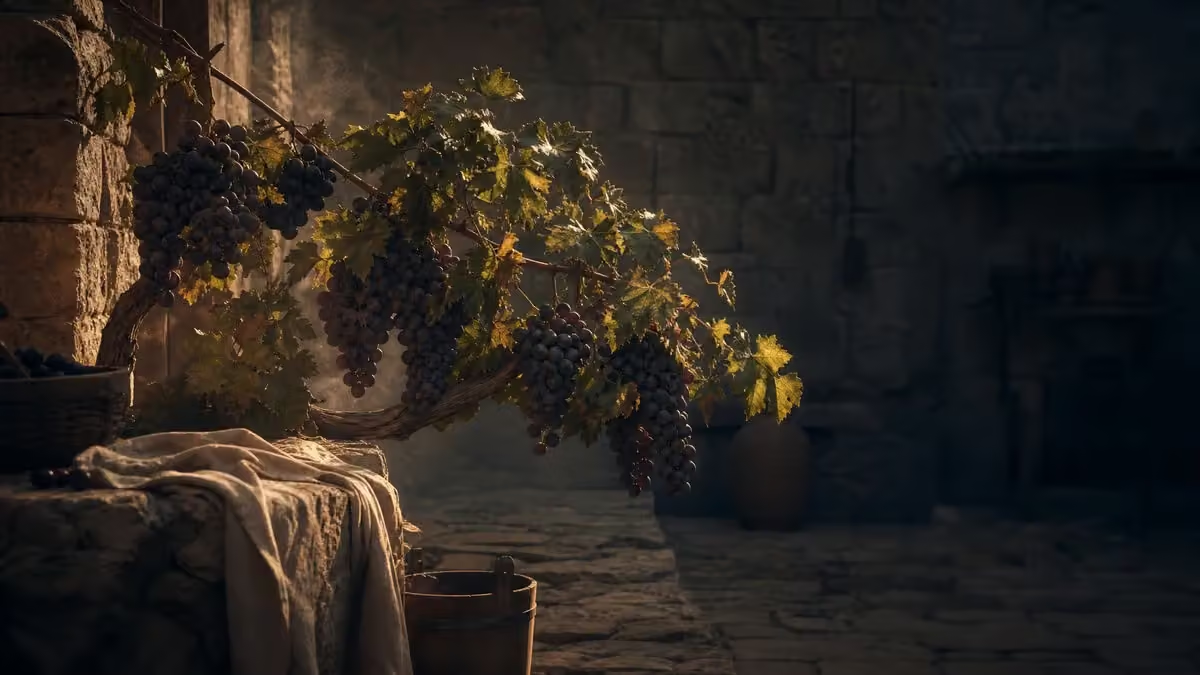
Singular. Fruit, not fruits. Nine qualities, one source. The Spirit does not hand out love to one believer and peace to another. He grows all nine in the same life, the way one tree carries its whole crop.
Love, joy, and peace
Love comes first because it is the root the other eight grow from. Jesus made it the mark of His own disciples.
A new commandment I give unto you, That ye love one another; as I have loved you, that ye also love one another. By this shall all men know that ye are my disciples, if ye have love one to another.
Not love as a feeling that comes and goes. Love as the thing the world is supposed to see and name.
Joy is not circumstance. Jesus promised it to His disciples the same night He told them He was leaving.
These things have I spoken unto you, that my joy might remain in you, and that your joy might be full.
He gave that promise hours before the cross. Joy was never going to depend on what was happening around them.
Peace is the same gift, given the same night.
Peace I leave with you, my peace I give unto you: not as the world giveth, give I unto you. Let not your heart be troubled, neither let it be afraid.
The world's peace depends on nothing going wrong. The Spirit's peace does not.
Longsuffering, gentleness, and goodness
Longsuffering is patience stretched out over time, with people who keep testing it.
With all lowliness and meekness, with longsuffering, forbearing one another in love;
Forbearing one another is not a one-time act. It is a posture held day after day.
Gentleness is strength under control, aimed at people, not withheld from them.
And the servant of the Lord must not strive; but be gentle unto all men, apt to teach, patient,
A servant of the Lord does not have to choose between being right and being gentle. The Spirit grows both.
Goodness is moral soundness that shows up in action, not just intention.
(For the fruit of the Spirit is in all goodness and righteousness and truth;)
Paul uses the same phrase here he used in Galatians. The fruit is one thing with many faces, and goodness is one of them.
Faith, meekness, and temperance
Faith here is not the initial act of trusting Christ for salvation. It is the ongoing trust that carries a believer through what cannot yet be seen.
Now faith is the substance of things hoped for, the evidence of things not seen.
Meekness is not weakness. It is power held in restraint, and Jesus attached a promise to it.
Blessed are the meek: for they shall inherit the earth.
The meek do not grab. They wait on God to give what He has already promised.
Temperance is self-control, the same word Paul used for an athlete disciplining his body for a prize that does not last.
And every man that striveth for the mastery is temperate in all things. Now they do it to obtain a corruptible crown; but we an incorruptible.
Nine qualities. One Spirit growing all of them, in the same person, over time.
Against such there is no law
Paul closes the list with a strange little phrase: against such there is no law.
No law stands against love, joy, peace, or any of the rest. No court anywhere convicts a person for having too much gentleness or too much self-control. These are not things God is watching to see if you can perform well enough to pass.
They are evidence. Evidence that the Spirit lives in a person and is doing what only He can do.
If we live in the Spirit, let us also walk in the Spirit.
Living in the Spirit comes first. Walking in Him, and the fruit that grows from that walk, follows. Paul never reverses that order, and neither should we.
So what is the fruit of the Spirit?
Not a checklist. Not nine boxes to tick before God will accept you.
One fruit, with nine parts. Grown by one source. Produced in a life that is already His.
Love. Joy. Peace. Longsuffering. Gentleness. Goodness. Faith. Meekness. Temperance.
Against such there is no law, because none of it was ever yours to produce on your own.
It is the Spirit's work, and the proof that He is doing it.
Look at your own life. Is that fruit growing, even slowly? That is not a question to answer with effort. It is a question to answer on your knees.
Continue the Story
People of the Bible
Who Was Lucius?
Who Was Lucius? You might not know his name, but Lucius was a key figure in the early church—a teacher and prophet who helped shape the gospel's spread to the Gentiles.
People of the Bible
Bible Characters in the New Testament: The Complete Guide
The complete guide to bible characters in the New Testament — from Jesus and the twelve apostles to Paul, Mary Magdalene, and the early church leaders.