
Bible & Scripture
Who were the Nephilim?
Short Answer
The Nephilim were extraordinary offspring produced when rebellious heavenly beings—the “sons of God”—took human women and fathered children through them (Genesis 6:1–4). They became powerful figures remembered as mighty men and giants. Rather than describing marriages between Sethites and Cainites, Genesis presents a supernatural rebellion in which divine beings crossed a God-ordained boundary between the heavenly and human realms.
The Nephilim first appear in one of the Bible's most mysterious passages:
As humanity multiplied, Scripture says:
“The sons of God saw the daughters of men that they were fair; and they took them wives of all which they chose.”
— Genesis 6:2, KJV
Then Genesis tells us:
“There were giants in the earth in those days; and also after that, when the sons of God came in unto the daughters of men, and they bare children to them…”
— Genesis 6:4, KJV
The most natural reading is that the “sons of God” were members of the heavenly host who rebelled against God, took human women, and produced the beings Scripture calls the Nephilim.
This was not merely another episode of human wickedness. It was a supernatural rebellion against the boundaries God had established between the heavenly and earthly realms.
Who Were the “Sons of God”?
The Hebrew expression translated “sons of God” is bene ha’elohim.
The clearest Old Testament parallels are found in Job:
Job 1:6
“Now there was a day when the sons of God came to present themselves before the LORD…”
Job 2:1 uses the expression again in the heavenly court.
And Job 38:7 describes the “sons of God” rejoicing when God created the earth—before humanity even existed.
In these passages, the sons of God are plainly heavenly beings.
That makes it difficult to suddenly interpret the same terminology in Genesis 6 as ordinary men from the family line of Seth.
Genesis itself gives us no indication that the phrase has suddenly changed meaning.
Why the Sethite Interpretation Does Not Fit the Text
A common interpretation says that the “sons of God” were supposedly the godly descendants of Seth, while the “daughters of men” were supposedly women descended from Cain.
But Genesis 6 never says this.
The passage never mentions Seth.
It never mentions Cain.
It never calls the men “sons of Seth.”
It never calls the women “daughters of Cain.”
Instead, it says the sons of God took the daughters of mankind.
The Hebrew expression translated “daughters of men” refers naturally to human women, not specifically Cainite women.
To arrive at the Sethite interpretation, those identities have to be inserted into the passage rather than drawn from it.
Were All of Seth's Descendants Really Godly?
There is another major problem.
Calling the sons of God the “godly line of Seth” assumes that Seth's descendants remained spiritually faithful simply because they descended from Seth.
Scripture never says that.
By the time of the Flood, God says:
The wickedness of man was great in the earth, and that every imagination of the thoughts of his heart was only evil continually.
The corruption was widespread.
The genealogy of Seth eventually leads to Noah, who was righteous—but that does not mean every male descendant of Seth was godly.
Likewise, Scripture never says that every woman descended from Cain was wicked.
The Sethite interpretation therefore creates two categories—godly Sethite men and ungodly Cainite women—that Genesis 6 itself never creates.
Why Would Ordinary Marriage Produce Nephilim?
This may be the biggest problem with the Sethite interpretation.
Genesis tells us that these unions were associated with the appearance of extraordinary beings:
The same became mighty men which were of old, men of renown.
If Genesis were simply describing believing men marrying unbelieving women, why would their children become the Nephilim?
Scripture contains many examples of spiritually inappropriate marriages.
None of them produce a new class of beings.
Nothing about a descendant of Seth marrying a descendant of Cain naturally explains the extraordinary offspring described in Genesis 6.
But if the fathers were supernatural beings and the mothers were human women, the unusual nature of their offspring makes sense within the narrative.
A Rebellion of Heavenly Beings
Genesis 6 fits into a larger biblical picture in which God has a heavenly host—spiritual beings who serve within His divine administration.
Some of these beings rebel against Him.
Genesis 6 records one such rebellion.
These heavenly beings did not merely reject God's authority spiritually; they left the realm and status assigned to them and violated the boundary between divine beings and humanity.
That makes Jude 6 extremely significant:
“And the angels which kept not their first estate, but left their own habitation, he hath reserved in everlasting chains under darkness unto the judgment of the great day.”
Jude describes angels who:
abandoned their proper position,
left their assigned dwelling,
committed a serious transgression,
and were subsequently imprisoned awaiting judgment.
The following verse speaks about sexual immorality and pursuing flesh outside its proper order.
This fits remarkably well with Genesis 6.
Peter Connects the Angelic Sin With Noah's Flood
2 Peter 2:4–5 provides another important connection:
“For if God spared not the angels that sinned, but cast them down to hell…”
“And spared not the old world, but saved Noah…”
Notice the sequence.
Peter speaks about:
Angels who sinned → divine imprisonment → the ancient world → Noah → the Flood.
That is exactly the setting of Genesis 6.
Peter and Jude therefore appear to be drawing upon the same ancient understanding of Genesis 6: rebellious heavenly beings committed a grave transgression and were placed under divine judgment.
This interpretation was also widespread in ancient Jewish thought surrounding the biblical world; Second Temple Jewish literature consistently connected the rebellious heavenly beings with the Nephilim episode. Peter and Jude show clear awareness of that interpretive tradition.
The Watchers
Ancient Jewish literature commonly referred to the rebellious heavenly beings associated with Genesis 6 as Watchers.
The term “watcher” itself occurs in Daniel 4, where it describes heavenly beings. Those watchers are holy; the term does not inherently mean an evil spirit.
Later Jewish tradition used the title for the rebellious heavenly beings associated with Genesis 6.
This background is useful because the New Testament writers were familiar with the supernatural framework surrounding the passage. Jude and Peter do not treat Genesis 6 as though it were merely a story about human intermarriage.
They describe an angelic rebellion.
The Nephilim Were Their Offspring
Genesis 6:4 connects the Nephilim with the union of the sons of God and human women:
“…when the sons of God came in unto the daughters of men, and they bare children to them…”
The Nephilim were therefore the offspring associated with this forbidden union.
They are described as:
extraordinary,
powerful,
“mighty men,”
“men of renown,”
and elsewhere associated with giant stature.
The supernatural nature of their parentage is more important than simply imagining extremely tall people.
The issue is not merely how big they were.
The issue is what they were.
They represented a corruption of God's intended ordering of creation.
Does “Nephilim” Mean “Fallen Ones”?
It is common to hear Nephilim translated as “fallen ones.”
That explanation is possible as a popular shorthand, but the Hebrew etymology is more complicated than simply deriving the word from the ordinary Hebrew verb naphal, “to fall.”
So it is better not to build the theology of Genesis 6 upon the definition “fallen ones.”
The identity of the Nephilim comes primarily from the context of Genesis 6, not from a speculative word derivation. Scholarship on the term also cautions against treating “fallen ones” as a settled lexical definition.
Why Did This Happen?
Genesis 6 should be understood against the backdrop of the larger supernatural conflict that begins in Eden.
In Genesis 3:15, God promises that the Seed of the woman will ultimately defeat the serpent.
From that point forward, Scripture follows both:
God's plan to redeem humanity
and
spiritual rebellion against God's purposes.
The Genesis 6 event represents an escalation of that rebellion.
Heavenly beings crossed a forbidden boundary, humanity became increasingly corrupt, violence filled the earth, and divine judgment followed.
Genesis says:
And GOD saw that the wickedness of man was great in the earth…
And:
The earth also was corrupt before God, and the earth was filled with violence.
The Nephilim episode therefore belongs within the broader picture of human rebellion and supernatural rebellion converging together.
Noah Was “Perfect in His Generations”
Genesis 6:9 says:
“Noah was a just man and perfect in his generations…”
The Hebrew word translated “perfect” (tamim) normally carries the idea of completeness, integrity, or being without defect.
Some have suggested that the statement refers specifically to Noah's genealogy remaining physically uncontaminated by the Genesis 6 corruption.
That possibility is intriguing given the surrounding context, but Scripture does not explicitly say that tamim refers to Noah's genetics.
The strongest point in the verse is that Noah stood apart from the surrounding corrupt world and walked with God.
We should therefore distinguish what Scripture clearly states from conclusions that remain possible but inferential.
“And Also After That”
Genesis 6:4 includes an extremely important phrase:
“There were giants in the earth in those days; and also after that…”
That becomes significant because Nephilim appear again after the Flood.
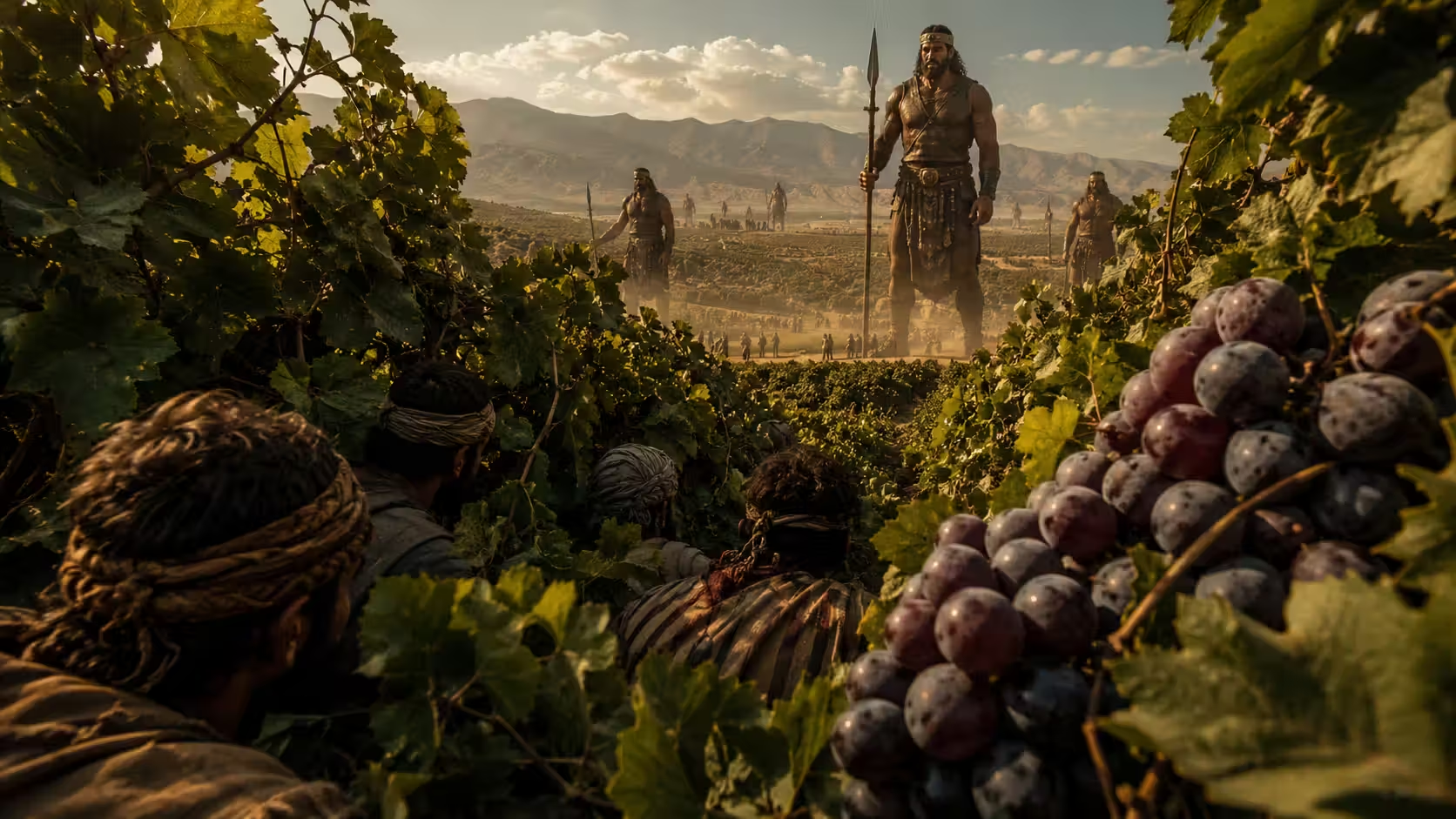
When Moses sent spies into Canaan, they returned terrified:
Numbers 13:33
“And there we saw the giants, the sons of Anak, which come of the giants…”
The Hebrew text uses Nephilim in this verse as well.
The spies identify the Anakim with the Nephilim tradition.
The Old Testament later describes several giant clans associated with the land, including the:
Anakim
Rephaim
and other unusually formidable peoples.
The biblical writers understood these populations within the same supernatural-geographical backdrop connected with Israel's conquest of Canaan. The Anakim are explicitly connected with the Nephilim in Numbers 13.
How Could Nephilim Exist After the Flood?
Genesis does not directly explain this.
That means we should be careful not to claim certainty where Scripture remains silent.
Two primary possibilities are commonly proposed.
One is that another supernatural transgression occurred after the Flood.
Another is that Genesis 6:4's phrase “and also afterward” describes the continuation or later reappearance of Nephilim-related peoples without explaining the mechanism.
What Scripture does tell us is enough:
Nephilim existed before the Flood, and the biblical text associates Nephilim with people encountered after the Flood.
Exactly how that happened is secondary to the biblical claim itself.
What About the Giants of Canaan?
Israel later encountered extraordinarily large warrior clans, particularly the Anakim and Rephaim.
Deuteronomy 2 describes peoples remembered as:
“A people great, and many, and tall…”
The conquest narratives repeatedly emphasize these giant clans.
Goliath himself was a giant warrior from Gath, one of the areas connected with the surviving Anakim:
Joshua 11:22
“There was none of the Anakims left in the land of the children of Israel: only in Gaza, in Gath, and in Ashdod, there remained.”
Later, Goliath comes from Gath.
The Bible does not directly call Goliath a Nephilim, so we should not claim that it does.
But he belongs to the larger biblical story of the giant clans associated with Canaan.
The Ancient Near Eastern Background
Genesis was written in an ancient world filled with stories about divine beings, demigods, giant heroes, and kings who claimed supernatural ancestry.
That does not mean Genesis copied pagan mythology.
Rather, Genesis frequently confronts and corrects the worldview of the surrounding nations.
In the ancient Near Eastern world, supernatural beings were sometimes portrayed as bringing forbidden knowledge to humanity or producing extraordinary offspring.
Genesis strips away the pagan glorification.
These beings are not noble gods blessing humanity.
They are rebels against Yahweh.
Their actions are not heroic.
They are transgression.
And their rebellion ends not in glory but in divine judgment.
Understanding this ancient context actually makes the supernatural interpretation of Genesis 6 stronger, because it places the passage within the conceptual world in which its original readers lived.
Key Scriptures
Genesis 6:1–4
The sons of God take human women and the Nephilim appear.
Genesis 6:5–13
Human corruption, violence, and God's judgment through the Flood.
Job 1:6; 2:1; 38:7
“Sons of God” describes members of the heavenly host.
Numbers 13:33
The Nephilim are identified in connection with the sons of Anak.
Deuteronomy 2:10–11, 20–21
Descriptions of the Anakim, Rephaim, and giant peoples.
Joshua 11:21–22
The Anakim are largely destroyed but remain in Gaza, Gath, and Ashdod.
2 Peter 2:4–5
Angels who sinned are judged immediately before Peter references Noah and the Flood.
Jude 6–7
Angels abandon their proper domain and are imprisoned for judgment.
Bottom line
Genesis 6 describes a genuine rebellion in the unseen realm that spilled into the human world. The Nephilim show us that the biblical story is far more supernatural than modern readers sometimes realize.
Continue Exploring
- Bible & ScriptureWhat does it mean that the Bible is inspired?When Christians say the Bible is “inspired,” they mean God breathed it out—that the Holy Spirit moved human authors to write exactly what He intended, in their own language and style, without error. The key verse is 2 Timothy 3:16, which literally says Scripture is “God-breathed.” This means the Bible is both fully divine and fully human: the genuine words of real men, superintended by God so that what they wrote is His Word.Read answer →

- Faith & SalvationWhy is Jesus the only way to God?Jesus is the only way to God because sin has separated every person from a holy God, and only Jesus can bridge that gap. He alone is fully God and fully man, the one mediator able to offer a perfect, sinless sacrifice. No amount of good works, sincerity, or religion can reconcile a guilty sinner to God. Jesus said, “I am the way, the truth, and the life: no man cometh unto the Father, but by me” (John 14:6).Read answer →
- Prophecy & End TimesWhat does the Bible say about Israel?The Bible presents Israel as God’s chosen nation—a people He called through Abraham, delivered from Egypt, and gave the land of Canaan. God made an unconditional covenant with them, and though they were scattered for disobedience, the prophets promised a future restoration. Paul insists God has not cast away His people. In this reading, the church and Israel are distinct, and God’s promises to Israel will be literally fulfilled.Read answer →

Still have a question?
Send it in and we will research it and write an answer.