
Scripture
What Does It Mean That Jesus Is the Lamb of God?
John the Baptist called Jesus a Lamb. Scripture had been pointing to that title since Egypt.
A man is standing by the Jordan River. A crowd has come out to hear him. Then he sees Jesus walking toward him, and instead of a sermon he says one sentence.
The next day John seeth Jesus coming unto him, and saith, Behold the Lamb of God, which taketh away the sin of the world.
A lamb.
Not a king. Not a conqueror. Not a judge, though He is all of those things. John the Baptist looks at the Son of God and reaches for an animal that gets led to slaughter without a sound.
He says it again the next day, to two of his own disciples.
And looking upon Jesus as he walked, he saith, Behold the Lamb of God!
John did not invent this title. He was handing his listeners a key that unlocked the whole Old Testament, and every Jew standing on that riverbank would have known it.
Why a lamb at all?
Go back to the night Israel left Egypt. God told every household to take a lamb, kill it, and put its blood on the doorposts of the house.
And the blood shall be to you for a token upon the houses where ye are: and when I see the blood, I will pass over you, and the plague shall not be upon you to destroy you, when I smite the land of Egypt.
The lamb did not die for its own sin. It had none. It died in the place of the firstborn son in that house. The blood on the door was not decoration. It was a substitute, marking out a family that judgment would pass over because something else had already died instead.
That is the first thread. A lamb, dying in someone else's place, so judgment passes by.
Why a silent lamb?
The second thread comes centuries later, through the prophet Isaiah, describing a suffering servant who does not yet have a name in the text.
He was oppressed, and he was afflicted, yet he opened not his mouth: he is brought as a lamb to the slaughter, and as a sheep before her shearers is dumb, so he openeth not his mouth.
A lamb being led to slaughter does not fight. It does not plead its case. It does not demand its rights. Isaiah is describing someone oppressed and afflicted who stays silent through it, not because He has no power to speak, but because the suffering is the point. It is doing something.
John the Baptist stood on the riverbank with both of those pictures already in his Bible. A lamb that dies in another's place. A lamb that suffers without protest. When he looked at Jesus and said "Behold the Lamb of God," he was telling Israel that both pictures had just become a person.
What did the title actually buy?
Peter, writing years later to believers scattered across the Roman world, spells out what the blood of this particular Lamb accomplished.
Forasmuch as ye know that ye were not redeemed with corruptible things, as silver and gold, from your vain conversation received by tradition from your fathers; But with the precious blood of Christ, as of a lamb without blemish and without spot:
Redeemed. Bought back. Not with money, which rusts and gets spent, but with blood, and not just any blood. A lamb without blemish and without spot. The Passover lamb had to be without defect. Isaiah's servant was innocent, oppressed unjustly. Peter is saying plainly: Jesus qualified. He had no sin of His own to die for, so His death could cover someone else's.
That is what the title claims. Not that Jesus was gentle, though He was. Not that He was meek, though He was that too. The title claims substitution. One dies so another does not have to. The title claims atonement. A debt gets paid in blood that was not the debtor's own.
Does the lamb stay dead?
No. And this is where the title stops looking backward and starts looking forward. In Revelation, John is given a vision of heaven's throne room, and he sees the same Lamb, standing, alive, but still carrying the marks of what He suffered.
And I beheld, and, lo, in the midst of the throne and of the four beasts, and in the midst of the elders, stood a Lamb as it had been slain, having seven horns and seven eyes, which are the seven Spirits of God sent forth into all the earth.
A Lamb standing, not lying dead on an altar. Slain, yet alive. And around that Lamb, a new song breaks out.
And they sung a new song, saying, Thou art worthy to take the book, and to open the seals thereof: for thou wast slain, and hast redeemed us to God by thy blood out of every kindred, and tongue, and people, and nation;
Saying with a loud voice, Worthy is the Lamb that was slain to receive power, and riches, and wisdom, and strength, and honour, and glory, and blessing.
The lamb in Egypt saved one household for one night. The Lamb of God redeems people out of every kindred, tongue, people, and nation, and He does it permanently. He is not only worthy to be worshipped. He is worshipped precisely because He was slain. The wound is not hidden in heaven. It is the reason for the song.
So what does it mean that Jesus is the Lamb of God?
It means a substitute died where you should have died.
It means the judgment that was coming for sin passed over, because blood was already on the door.
It means He went to that death silently, without protest, because the suffering itself was the point.
It means you were not bought with silver or gold, which spend and rust, but with blood that had no defect in it.
It means the Lamb did not stay dead. He stands now, worthy of the song heaven is already singing.
He takes away the sin of the world, and He is still standing.
That is who John pointed to on the riverbank. Have you looked at Him the way John told you to?
Continue the Story
Scripture
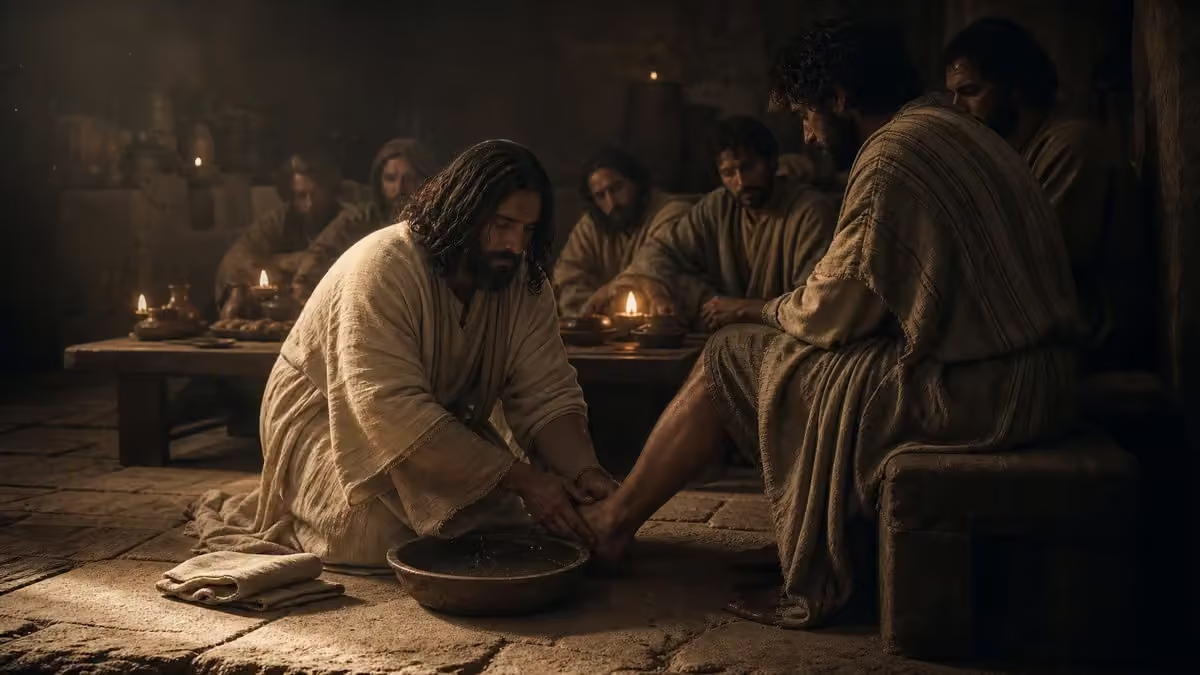
Why did Jesus wash the disciples' feet?
Jesus took a towel and a basin the night before He died. What He was doing was bigger than clean feet.
Scripture
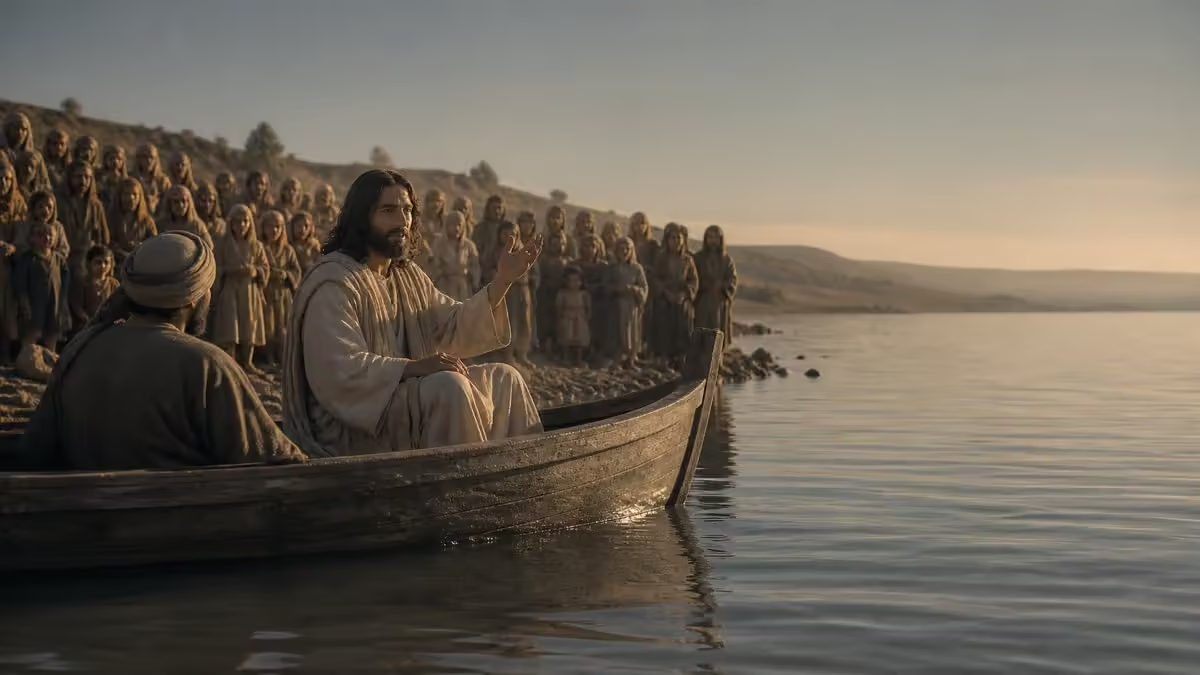
Why did Jesus speak in parables?
Jesus didn't hide the kingdom to keep people out. A parable opens one heart and closes another, depending on what the hearer already refused.