
Scripture
What Does It Mean to Be a Living Sacrifice?
Paul says to offer your body as a sacrifice that stays alive. Here is what that actually asks of you.
What does it mean to offer God a sacrifice that is still alive?
A sacrifice, in the Bible's own logic, dies. You bring the animal, the animal goes on the altar, the fire does its work, and that is the end of it.
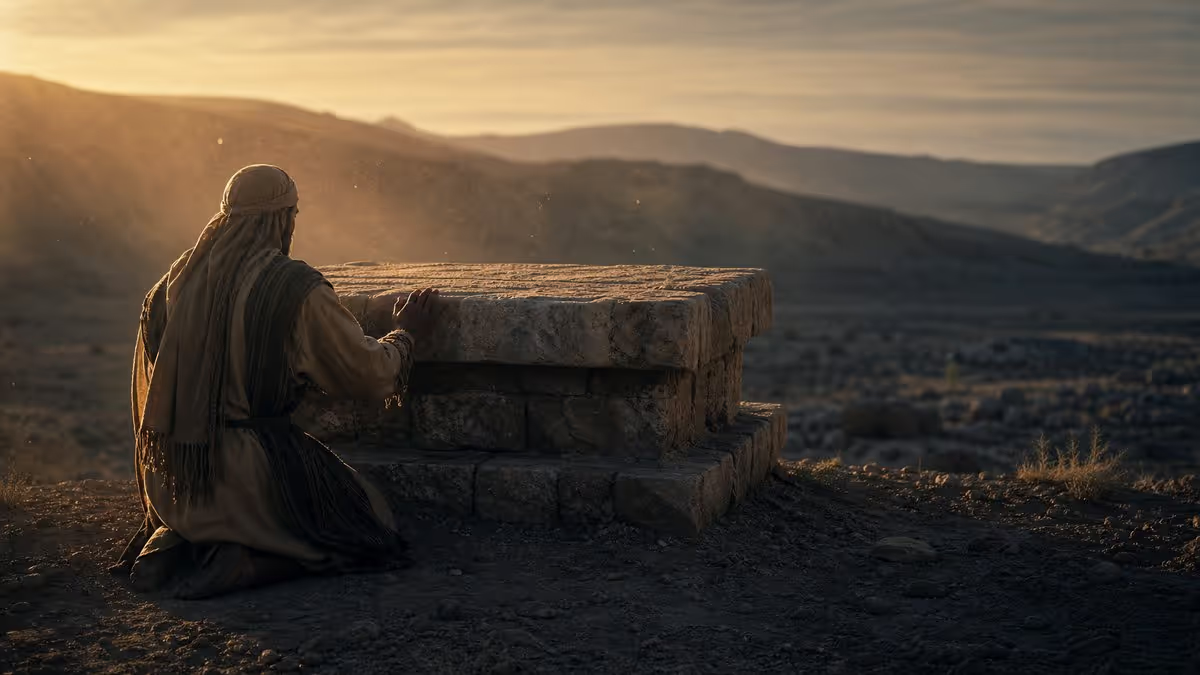
So when Paul tells believers to present their bodies as a sacrifice, and then says "living," he is asking for something that has never been asked for before. Not a death. A life, handed over and kept moving.
I beseech you therefore, brethren, by the mercies of God, that ye present your bodies a living sacrifice, holy, acceptable unto God, which is your reasonable service.
That is not the opening line of the letter. It is the twelfth chapter.
Why does Paul wait until chapter twelve to ask for this?
Eleven chapters come before this verse. Sin laid out plainly. The law's failure to save anyone. Justification by faith. The wretched man who cannot do the good he wants. No condemnation for those in Christ. Israel's place in God's plan. Mercy on top of mercy.
Then "therefore."
Paul does not ask for a living sacrifice to earn anything. He asks for it because of what has already been given. "By the mercies of God." The appeal comes after the gift, not before it. He is not negotiating for grace. He is responding to it.
That order matters. A living sacrifice offered to earn favor is a transaction. A living sacrifice offered because favor has already been shown is worship.
Why a living sacrifice instead of a dead one?
Every sacrifice an Israelite ever brought to the altar pointed somewhere. A lamb, a goat, a bull, laid down once and consumed. The old system worked in single transactions. Bring the animal, it dies, you go home.
God is not asking believers to go to an altar once. He is asking for a body that keeps walking around, keeps making decisions, keeps waking up tomorrow, all of it handed over.
Paul had already made this exact point back in chapter six, in different words.
Neither yield ye your members as instruments of unrighteousness unto sin: but yield yourselves unto God, as those that are alive from the dead, and your members as instruments of righteousness unto God.
"Alive from the dead." That is the whole picture. You were dead in sin. Now you are alive. The parts of you that used to serve sin, your hands, your eyes, your time, your mouth, now belong to someone else. Not destroyed. Redirected.
A living sacrifice does not get used once and burned up. It gets up the next morning and offers itself again.
What does "reasonable service" mean?
Paul calls this "your reasonable service." Not an extreme ask. Not a demand reserved for the especially devoted. The ordinary, sensible response of someone who has actually understood what was done for them.
Think about what that implies. If God has shown this kind of mercy, holding something back is the strange choice, not the normal one. Giving your body, your plans, your ordinary hours, is not a leap of extraordinary piety. It is what makes sense once you know what you were saved from and who paid for it.
This is not a special tier of Christian living for the zealous few. It is the baseline Paul expects of "brethren," meaning everyone he is writing to.
How does the mind fit into a sacrifice made with the body?
Paul does not stop at the body. The very next verse turns to the mind.
And be not conformed to this world: but be ye transformed by the renewing of your mind, that ye may prove what is that good, and acceptable, and perfect, will of God.
Two verbs, pulling in opposite directions. "Conformed" means pressed into a shape from the outside. The world has a mold, and it is constantly pressing. "Transformed" means changed from the inside, by a renewed mind, not by willpower applied to the old one.
A living sacrifice is not only a body that shows up in the right places doing the right things while the mind runs on the world's settings underneath. The mind gets offered too. What you think about, what you let shape your opinions, what you assume is normal, all of it comes under the same offering as the body does.
And the result of that renewed mind is not a vague spiritual feeling. Paul says you will "prove" God's will, meaning you will test it and find out for yourself that it is good, acceptable, and perfect. Not perfect in some abstract sense you take on faith forever. Proven, by living it.
What does this look like in an ordinary life?
Peter picks up the same picture and gives it a different shape.
Ye also, as lively stones, are built up a spiritual house, an holy priesthood, to offer up spiritual sacrifices, acceptable to God by Jesus Christ.
"Lively stones." Living stones, built into something, offering up sacrifices through Jesus Christ. Every believer, a priest. Every believer, something to offer. Not animals. Not grain. Bodies and minds.
That is what makes this an ordinary-day doctrine and not a once-a-year ritual. A living sacrifice does not get offered at a special altar on a special occasion. It gets offered in the car, at the table, at work, in an argument you choose not to have, in the thought you choose not to finish.
So what does it mean to be a living sacrifice?
A body handed over, not destroyed, but redirected.
A mind renewed, not conformed to what everyone around you assumes is normal.
An offering made daily, not once, because the sacrifice stays alive.
A response to mercy already given, not a bargain for mercy not yet granted.
Holy, acceptable, and reasonable, because of what God has already done.
What did you hand God this morning? What is still sitting on the altar, waiting?
Continue the Story

Scripture
What is the fruit of the Spirit?
Nine words in Galatians 5 describe what the Spirit grows in a believer, not what a believer performs for God.
People of the Bible
Who Was Lucius?
Who Was Lucius? You might not know his name, but Lucius was a key figure in the early church—a teacher and prophet who helped shape the gospel's spread to the Gentiles.