
Scripture
What happened at the Tower of Babel, and why does it matter?
Babel was never about how tall the tower was. It was about a name men grabbed for themselves, instead of the name God gives.
God told Noah's sons to fill the earth, and Babel's builders refused.
A tower, a flood story just behind it, a strange scattering of languages. What is actually happening in Genesis 11?
Start with the command God had already given.
And God blessed Noah and his sons, and said unto them, Be fruitful, and multiply, and replenish the earth.
Now read what the men of Shinar said to one another.
And they said, Go to, let us build us a city and a tower, whose top may reach unto heaven; and let us make us a name, lest we be scattered abroad upon the face of the whole earth.
Put the two sentences side by side. God said fill the earth. They said, let us not be scattered. The tower is not the sin. The sentence underneath it is.
They did not want to spread out. They wanted to stay put, build big, and make a name for themselves. Not the name God gives. A name they take.
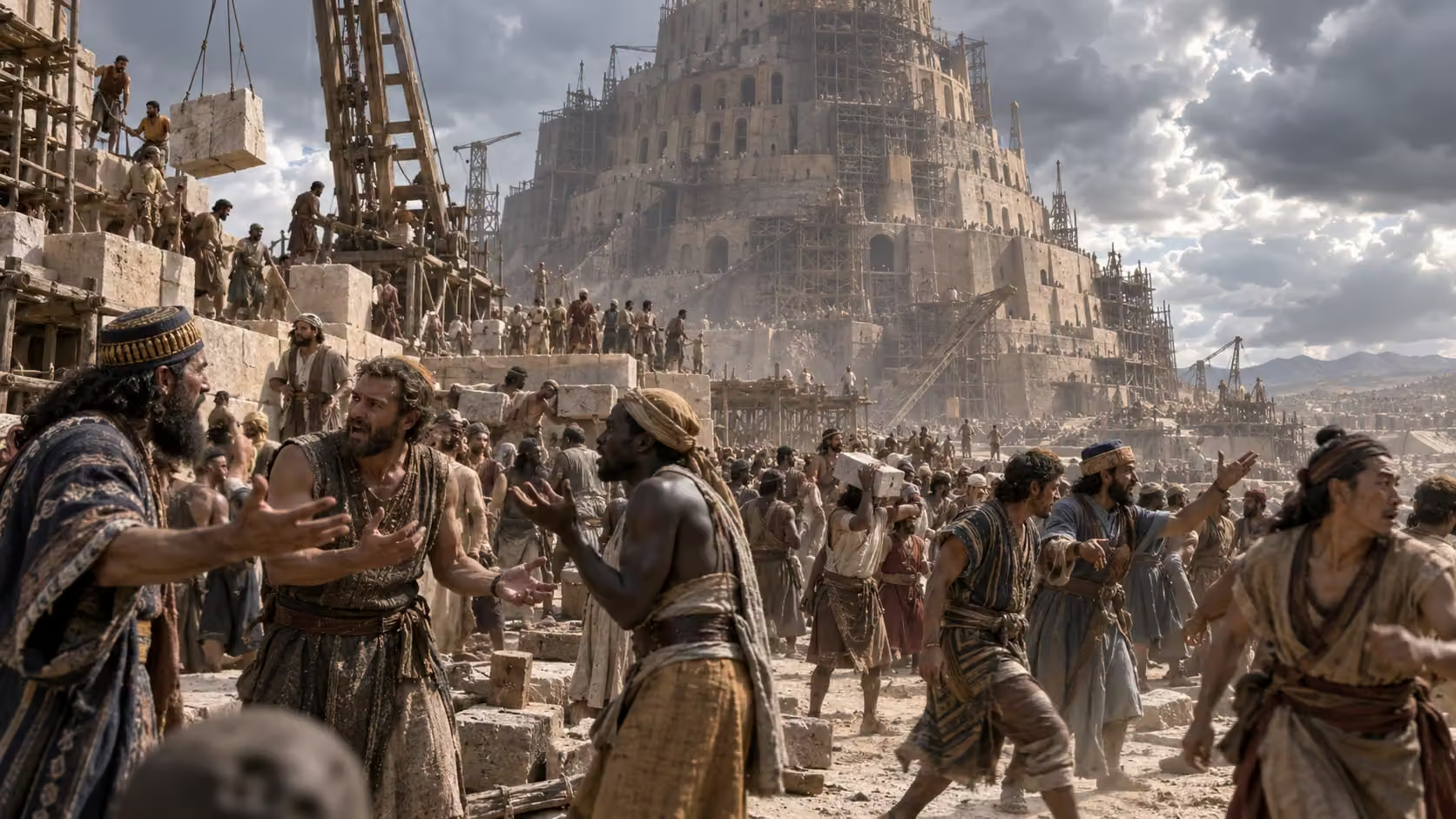
The tower they built was a ziggurat, and the builders of Babylon left the receipts.
Genesis tells us exactly how they built.
And they said one to another, Go to, let us make brick, and burn them throughly. And they had brick for stone, and slime had they for morter.
Kiln-fired brick set in bitumen mortar is exactly how the ziggurats of ancient Mesopotamia were built — a stepped, rectangular mountain of brick with a temple on top, meant to lift the priest toward the gods. This land already had a name attached to it.
And the beginning of his kingdom was Babel, and Erech, and Accad, and Calneh, in the land of Shinar.
Nimrod's kingdom began in Shinar, and Babel is named first among its cities. Babylon's own ziggurat to the god Marduk carried a name that meant "temple of the foundation of heaven and earth," and a royal inscription boasted: "I raised its top to heaven." That is the same boast Genesis 11:4 puts in the builders' mouths. The history is background. The text is the point.
The Lord came down to see the city, and the scattering He sent was the blessing He had already promised.
Here is the heart of the account, and it is written as an irony.
And the Lord came down to see the city and the tower, which the children of men builded.
A tower built to reach heaven, and God has to come down to look at it. That sentence is the judgment before the judgment arrives.
And the Lord said, Behold, the people is one, and they have all one language; and this they begin to do: and now nothing will be restrained from them, which they have imagined to do.
God does not object to unity itself. He states the danger of unity turned toward rebellion: one people, one tongue, one refusal of His command, and nothing they imagine will be restrained. So He acts.
So the Lord scattered them abroad from thence upon the face of all the earth: and they left off to build the city.
Therefore is the name of it called Babel; because the Lord did there confound the language of all the earth: and from thence did the Lord scatter them abroad upon the face of all the earth.
Babel, from a Hebrew word that means to confuse. The city that tried to make itself a name got a name that means confusion instead.
And notice what the scattering actually was. Not a new punishment invented on the spot, but the very thing God had already commanded and blessed in Genesis 9:1. Judgment and mercy arrived in the same act.
Babel never stayed a ruin; it became Babylon, and Scripture never stopped talking about it.
The name does not end at Genesis 11:9. Babel is the Hebrew name for Babylon, and the city on the Euphrates runs through the whole Bible — the empire that carried Judah into captivity, and further still, into the last book of the Bible.
And upon her forehead was a name written, MYSTERY, BABYLON THE GREAT, THE MOTHER OF HARLOTS AND ABOMINATIONS OF THE EARTH.
For her sins have reached unto heaven, and God hath remembered her iniquities.
Read that phrase again: sins that have reached unto heaven. That is the exact language of the tower whose top was meant to reach unto heaven (Genesis 11:4). The city that started as a bid for a name ends the Bible as the name for everything opposed to God.
And against that, set two promises. God told Abram, called out of that same land, "I will bless thee, and make thy name great" (Genesis 12:2) — the name men could not build for themselves, God gives freely. And He promised through Zephaniah that the scattering would not be the last word:
For then will I turn to the people a pure language, that they may all call upon the name of the Lord, to serve him with one consent.
Men tried to make a name for themselves and lost even their own tongue. God makes a name for the man who trusts Him, and promises a day when every tongue calls on His name instead.
Where sincere Christians differ
Who is the Babylon of Revelation 17 and 18? Some read her as Rome, or as a corrupt religious and commercial system rather than one city. Others read the text plainly, as a real city rebuilt on the Euphrates and judged in the last days. Even among those who take it literally, good teachers differ over whether the chapters describe two sides of one power or the same city seen twice.
Ark Life holds the premillennial reading, with a literal seven-year Tribulation before Christ returns, and reads Revelation 17-18 as a real city whose fall is the last echo of the tower whose top was supposed to reach heaven. But the passage's main point does not wait on that question being settled. The name men build for themselves does not stand, wherever it finally falls.
So what happened at Babel, and why does it matter?
Men refused to be scattered. God scattered them anyway, because the scattering was the blessing all along.
They wanted a name. They got a word that means confusion.
The city did not die there. It grew into Babylon, and Babylon's sins reached unto heaven, the very words the tower once boasted.
But the story does not end at a ruin. On the day of Pentecost, in a crowd that included "the dwellers in Mesopotamia" — the land of Babel itself — the Spirit did something that looks like the mirror image of Babel.
Now when this was noised abroad, the multitude came together, and were confounded, because that every man heard them speak in his own language.
Cretes and Arabians, we do hear them speak in our tongues the wonderful works of God.
At Babel, one language became many, and men were scattered. At Pentecost, many languages heard one message, and men were gathered. The Spirit did not erase the languages and hand back a single tongue. He filled every tongue with the same message. That is the reversal.
And the last picture the Bible gives is not one tongue either.
After this I beheld, and, lo, a great multitude, which no man could number, of all nations, and kindreds, and people, and tongues, stood before the throne, and before the Lamb, clothed with white robes, and palms in their hands;
All nations. All tongues. Not erased. Gathered.
What happened at Babel? Men grabbed for a name and lost their own words to say it in. What does it matter? Because the name we build for ourselves never survives, and the name God gives never fails. Every tongue that was scattered at Babel will one day stand before the throne, speaking its own language, saying the same thing. The name that lasts is the one He gives.
What name are you building for yourself right now? Whatever it is, it will not outlast the one He offers you for free.
Continue the Story
People of the Bible
The Story of Joseph in the Bible: From Pit to Palace
The story of Joseph in the Bible is one of the most dramatic and emotionally rich narratives in all of Scripture.
People of the Bible
The Story of Noah and the Ark: Faith, Flood, and a New Beginning
The story of Noah and the ark is one of the most recognizable stories in all of Scripture. It appears in Genesis 6–9 and tells of a man who trusted God completely — even when what God asked seemed impossible.