

Scripture
What is the parable of the good Samaritan?
The story isn't about being nice to strangers. It's Jesus closing a loophole a self-justifying man was looking for.
A man stands up in front of a crowd and asks Jesus a question everyone around him would have nodded at: what must I do to inherit eternal life?
It sounds like a good question. It is not an innocent one.
A man stood up to test Him with the one question the Law cannot answer
Luke tells us plainly what this was. "A certain lawyer stood up, and tempted him" (Luke 10:25). This was not a courtroom attorney. He was a doctor of the Law, a man who had spent his life inside Deuteronomy and Leviticus, and he was testing the new Teacher to see if He was sound.
Jesus does not argue with him. He hands the question back.
And, behold, a certain lawyer stood up, and tempted him, saying, Master, what shall I do to inherit eternal life? He said unto him, What is written in the law? how readest thou? And he answering said, Thou shalt love the Lord thy God with all thy heart, and with all thy soul, and with all thy strength, and with all thy mind; and thy neighbour as thyself. And he said unto him, Thou hast answered right: this do, and thou shalt live.
The lawyer gives the right answer, quoting Deuteronomy 6:5 and Leviticus 19:18 word for word, and Jesus tells him he has answered right. "This do, and thou shalt live" is not a ladder Jesus expects him to climb. It is the standard, and the standard is the problem, because no one has ever kept it.
That is why the very next verse turns.
But he, willing to justify himself, said unto Jesus, And who is my neighbour?
He cannot say he loves God with everything he has, or his neighbour as himself. So he narrows the word neighbour until it fits something he has actually done.
Jesus answers him with a story.
The road down to Jericho was a place where men were left half dead
And Jesus answering said, A certain man went down from Jerusalem to Jericho, and fell among thieves, which stripped him of his raiment, and wounded him, and departed, leaving him half dead.
This was not abstract to the listeners. The road from Jerusalem down to Jericho ran fifteen to twenty-one miles through rocky desert, full of caves bandits used for cover, and was later known as the "bloody way." Jericho was a priestly town, so a priest or a Levite on that road was an everyday sight, not a plot device.
The wounded man is given no name. He is stripped, beaten, and left half dead — a phrase Luke uses nowhere else in his Gospel. He could be anyone. He could be you.
The men who knew the Law best gave the wounded man the widest berth
And by chance there came down a certain priest that way: and when he saw him, he passed by on the other side. And likewise a Levite, when he was at the place, came and looked on him, and passed by on the other side.
Both men saw him and passed by on the far side. Jesus gives no reason for either one. People have guessed since — fear of ambush, fear of corpse-defilement under Numbers 19:11 — and either might be true. But the text offers no excuse, and Jesus offers none either. These were the men who had just recited the Law's summary back to Him. They had it in their mouths. They did not have it in their legs.
A Samaritan spent what he had on a man who would have crossed the road to avoid him
Here is where the story turns. A Samaritan was not a random passerby — Jews and Samaritans did not deal with each other.
Then saith the woman of Samaria unto him, How is it that thou, being a Jew, askest drink of me, which am a woman of Samaria? for the Jews have no dealings with the Samaritans.
The hostility ran deep, back to the Assyrian resettlement of Samaria generations before, and it was still live in Jesus' own day: "Say we not well that thou art a Samaritan, and hast a devil?" (John 8:48). This was the one man in the story the lawyer would have crossed the street to avoid.
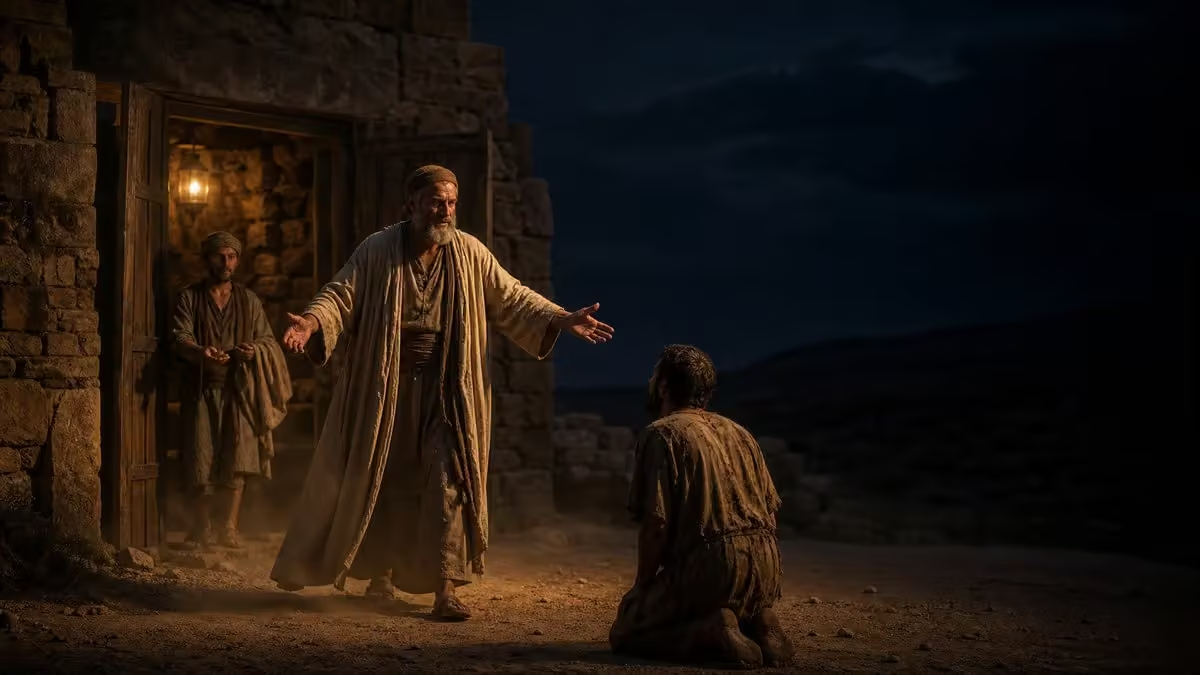
But a certain Samaritan, as he journeyed, came where he was: and when he saw him, he had compassion on him, And went to him, and bound up his wounds, pouring in oil and wine, and set him on his own beast, and brought him to an inn, and took care of him. And on the morrow when he departed, he took out two pence, and gave them to the host, and said unto him, Take care of him; and whatsoever thou spendest more, when I come again, I will repay thee.
He came near. He bound the wounds, poured in oil and wine, set the man on his own animal, walked, brought him to an inn, stayed the night, paid two days' wages up front, and promised to cover whatever more it cost.
Five decisions. Every one of them cost him something — his time, his supplies, his own beast, his coin, his open-ended promise. Compassion in this story is not a feeling that passed through him on the road. It is a bill he chose to pick up for a stranger who hated people like him.
Jesus turns "who is my neighbour?" into "whose neighbour will you be?"
Which now of these three, thinkest thou, was neighbour unto him that fell among the thieves? And he said, He that shewed mercy on him. Then said Jesus unto him, Go, and do thou likewise.
Notice what the lawyer cannot bring himself to say. Not "the Samaritan." He says "he that shewed mercy on him," working around the word rather than using it. Jesus does not correct the dodge; He simply closes the trap.
This is Law, and Law cannot save a man who has already failed it. We do not read "go and do likewise" as a way to earn eternal life — "for by grace are ye saved through faith; and that not of yourselves: it is the gift of God: not of works, lest any man should boast" (Ephesians 2:8-9). Mercy like the Samaritan's is not the price of salvation. It is the family likeness of everyone who has already been shown it: "if ye fulfil the royal law according to the scripture, Thou shalt love thy neighbour as thyself, ye do well" (James 2:8).
Where sincere Christians differ
Good churches read this parable two ways.
Allegory, from Augustine onward and in Matthew Henry, reads each detail separately: the traveller is fallen man, the robbers are Satan, the Samaritan is Christ, the inn is the church, the two pence the sacraments or the two Testaments. It preaches well, but makes the story say more than the text says.
One point, plainly read, holds that the parable makes a single point — neighbour-love crosses every boundary and costs something — and the details are there for realism, not decoding.
We hold the second, with the lawyer's question in view. Having read it plainly, we may still say with Matthew Henry that the Samaritan's mercy shows the shape of Christ's — as application, not as hidden code.
So what is the parable of the good Samaritan?
It is not a story about being nice.
It is Jesus answering a man trying to shrink the Law until he could claim to have kept it.
It is a road where the ones who knew Scripture best walked past, and the one man everyone despised stopped.
It is five costly decisions standing in for one word — mercy — and a question flipped from who deserves my help to who will I actually help.
And underneath it is the greater Samaritan. He came down from heaven. He came near to people who had every reason to resent Him. He paid what we owed, in full, and He is coming again.
He showed us mercy first. That is why we can go, and do likewise.
Who have you walked past this week? There is still time to go back.
Continue the Story
Scripture
What is the parable of the prodigal son?
Jesus told this story to answer religious men angry that He ate with sinners. It still answers that complaint.

Scripture
What does it mean to be salt and light?
Jesus calls His disciples salt and light. Here is what that actually required of them, and requires of us.