
Scripture
What is the parable of the prodigal son?
Jesus told this story to answer religious men angry that He ate with sinners. It still answers that complaint.
The parable of the prodigal son is the most familiar story Jesus told, and the easiest one to file under "the story of a bad man who repented."
That is not why Jesus told it.
Luke sets the scene before the story starts. Tax collectors and sinners are crowding in to hear Jesus, and the religious leaders do not like what that crowd means about Him.
Then drew near unto him all the publicans and sinners for to hear him. And the Pharisees and scribes murmured, saying, This man receiveth sinners, and eateth with them.
Everything that follows is Jesus answering that complaint.
Jesus told this story to men who were angry that He ate with sinners.
He does not answer with an argument. He answers with three stories about losing things.
A shepherd leaves ninety-nine sheep in the wilderness to find one. A woman sweeps her whole house for one lost coin. Both call their friends together when they find what they lost, and both stories end the same way.
I say unto you, that likewise joy shall be in heaven over one sinner that repenteth, more than over ninety and nine just persons, which need no repentance.
Then comes the third story, and this one does not end with a tidy declaration of joy. It ends with a feast already underway and one man standing outside, refusing to come in. The man who told it was looking at the men who were standing outside right then.
The younger son asked for his inheritance, and in that world that meant he wished his father dead.
"Father, give me the portion of goods that falleth to me" (Luke 15:12). Under the law, the younger of two sons stood to receive one-third of the estate when his father died (Deuteronomy 21:17). Asking for it early, while the father was still alive and still running the household, was not an awkward request. In the culture Jesus and His hearers lived in, it said the father was in the way.
The father grants it anyway. The son converts it to cash, leaves for a far country, and wastes it on riotous living. Then the money runs out.
And he would fain have filled his belly with the husks that the swine did eat: and no man gave unto him.
Feeding pigs was about as low as a Jewish man could sink -- unclean animals, someone else's field, and he is hungry enough to envy what they are eating. No man gave unto him. He is further from home than the money ever took him.
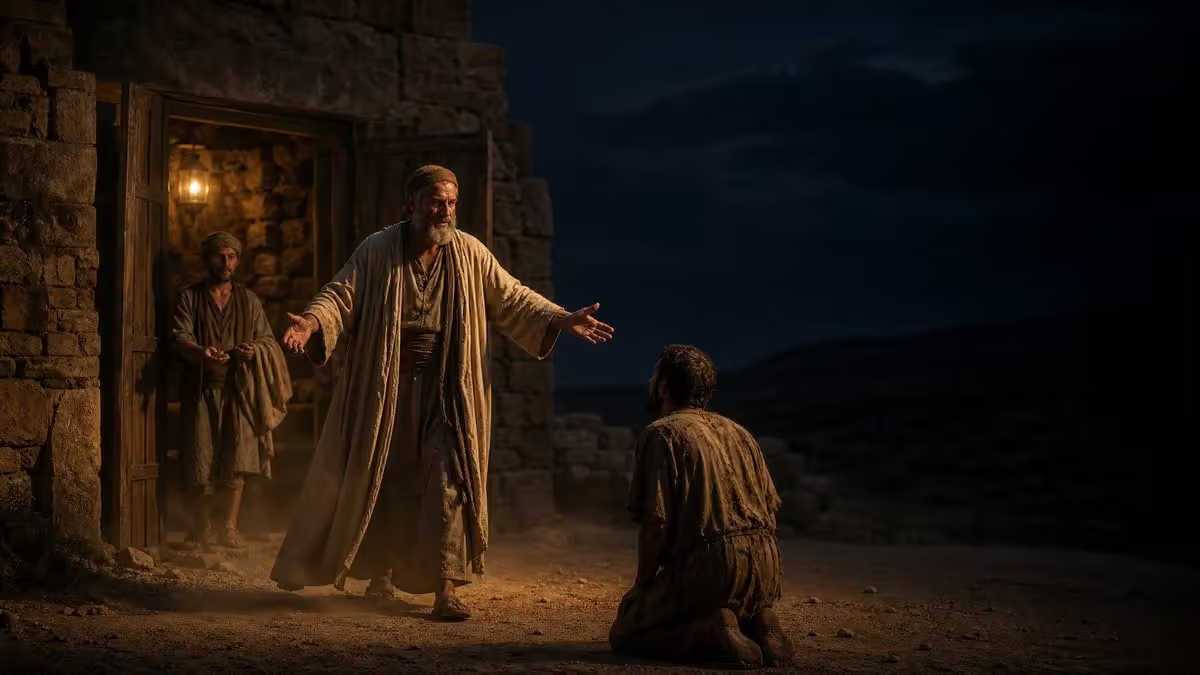
The father saw him a great way off, and ran.
The son rehearses a speech. He will say he has sinned, that he is not worthy to be called a son, that he will come back as a hired servant. He never gets to finish it.
And he arose, and came to his father. But when he was yet a great way off, his father saw him, and had compassion, and ran, and fell on his neck, and kissed him.
A man of standing did not run. Running meant gathering up the robe and showing his bare legs in the road, and that was beneath him. The father runs anyway, reaching his son before the boy can even finish asking to be made a servant.
But the father said to his servants, Bring forth the best robe, and put it on him; and put a ring on his hand, and shoes on his feet: And bring hither the fatted calf, and kill it; and let us eat, and be merry: For this my son was dead, and is alive again; he was lost, and is found. And they began to be merry.
The robe was the best one in the house, kept for a feast. The ring marked authority and standing -- the kind Pharaoh gave Joseph (Genesis 41:42). Shoes said he was a son, not a slave; slaves went barefoot. The calf was fattened for a great occasion and would feed the whole household. None of it was earned. The offer to become a hired servant is never made, because the father does not let him finish.
The older brother was lost in his own father's field.
He hears music from the house and asks a servant what it means. When he learns his brother is home, he will not go in.
And he answering said to his father, Lo, these many years do I serve thee, neither transgressed I at any time thy commandment: and yet thou never gavest me a kid, that I might make merry with my friends: But as soon as this thy son was come, which hath devoured thy living with harlots, thou hast killed for him the fatted calf.
He calls his brother "this thy son," not "my brother." He accuses him of a sin the story never records -- the narrator never said anything about harlots. He has kept every rule and feels cheated for it, standing in his father's own field, just as lost as his brother ever was in the far country.
And the father goes out to him too. The same humiliating movement, twice in one day.
And he said unto him, Son, thou art ever with me, and all that I have is thine.
The story ends there. No recorded answer from the older son. The men Jesus was answering were standing right in front of Him.
Where sincere Christians differ
Some read this as the conversion of a sinner who was never truly a son, with the older brother standing in for the self-righteous who are not saved either. Others read the younger son as a believer who wandered, lost his joy and his place at the table, and was restored -- a story about fellowship, not entrance into the family. Sincere Bible-believing Christians hold both readings, and this parable is not the place to settle the question of whether a true believer can be eternally lost. What the text says plainly is that the Father receives the repentant freely, that He casts out none who come to Him (John 6:37), and that the greater danger in this story is not the far country. It is the bitter heart standing outside the feast.
So what is the parable of the prodigal son about?
A father who runs.
A robe, a ring, a pair of shoes.
A feast nobody earned.
Two sons, both lost -- one in a far country, one in his father's own field.
One road home, and a Father already watching for it.
The repentance in this story is real. The son does come to himself, and he does go home. But the father does not wait for a finished sentence before he runs, and he does not wait for an apology from the older son before he goes out to plead with him either. The welcome was never a wage.
It was grace, running down the road before the son could even ask for it.
You are either the son in the far country or the son standing outside the feast. The Father is already coming out to find you.
Continue the Story

Scripture
What is the parable of the good Samaritan?
The story isn't about being nice to strangers. It's Jesus closing a loophole a self-justifying man was looking for.

Scripture
What does it mean to be salt and light?
Jesus calls His disciples salt and light. Here is what that actually required of them, and requires of us.