
Scripture
What is the parable of the sower?
Jesus told one story about seed and soil to explain why the same gospel produces four different responses in four different hearts.
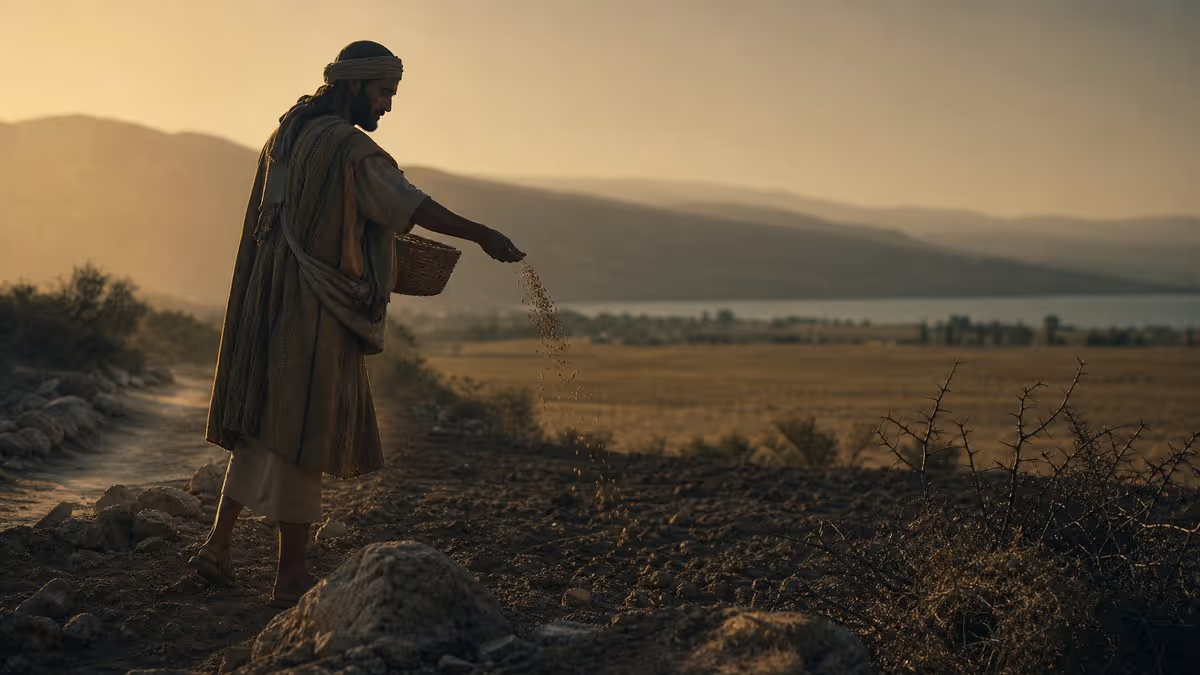
A farmer throws seed across a field. Some of it never grows. Some of it grows fast and dies faster. Some of it grows and gets strangled. And some of it grows into a harvest no one could have predicted.
That is the whole parable. Jesus told it to a crowd so large He had to sit in a boat and teach them from the water.
And he spake many things unto them in parables, saying, Behold, a sower went forth to sow;
One sower. One seed. Four kinds of ground. The question the parable asks is not complicated. Why does the same word land so differently in different people?
What happened to the seed that fell by the way side?
And when he sowed, some seeds fell by the way side, and the fowls came and devoured them up:
The path running along the edge of the field is packed hard by foot traffic. The seed never gets in. It sits on top of the ground until a bird takes it.
Jesus explains this one plainly later in the chapter.
When any one heareth the word of the kingdom, and understandeth it not, then cometh the wicked one, and catcheth away that which was sown in his heart. This is he which received seed by the way side.
The word is heard and gone in the same moment. Not rejected out loud. Not argued with. Just never let in. The enemy does not have to fight for ground that was never broken up in the first place.
What happened to the seed on the stony ground?
This one looks like success at first.
Some fell upon stony places, where they had not much earth: and forthwith they sprung up, because they had no deepness of earth: And when the sun was up, they were scorched; and because they had no root, they withered away.
A thin layer of soil over a shelf of rock warms up fast, so the seed sprouts quickly. There is nothing underneath for the roots to reach. The first real heat finishes it.
But he that received the seed into stony places, the same is he that heareth the word, and anon with joy receiveth it; Yet hath he not root in himself, but dureth for a while: for when tribulation or persecution ariseth because of the word, by and by he is offended.
Notice the joy is real. The response is fast and glad. What is missing is root. The first cost the word asks for, he is gone. Nothing underneath to hold him when the sun comes up.
What happened to the seed among the thorns?
And some fell among thorns; and the thorns sprung up, and choked them:
This ground is not hard, and it is not shallow. The seed grows. So does everything else already planted there, and the thorns win the race.
He also that received seed among the thorns is he that heareth the word; and the care of this world, and the deceitfulness of riches, choke the word, and he becometh unfruitful.
This is the soil most of us are likely standing in, and the easiest one to miss. No crisis kills this man's faith. No persecution touches him. He is just crowded. Worry about this life and the pull of money grow up alongside the word until the word cannot breathe. He does not fall away. He goes unfruitful, which is its own kind of loss.
Why would the same message land so differently in four hearts?
The disciples asked Jesus directly why He taught this way at all.
And the disciples came, and said unto him, Why speakest thou unto them in parables?
His answer is not what we would expect from a teacher trying to win a crowd.
Therefore speak I to them in parables: because they seeing see not; and hearing they hear not, neither do they understand.
A parable does two things at once. To someone who wants to understand, it opens the door wider, because a story stays with you and keeps working after the sermon ends. To someone who has already made up his mind, it tells him nothing, because he was never going to receive it however it was said.
But blessed are your eyes, for they see: and your ears, for they hear. For verily I say unto you, That many prophets and righteous men have desired to see those things which ye see, and have not seen them; and to hear those things which ye hear, and have not heard them.
The difference between the four soils was never the seed. The sower does not sow a weaker word on the path and a stronger word on the good ground. He throws the same seed everywhere. The difference the parable is asking us to see is the condition of the ground before the seed ever lands.
What does Jesus say the good ground actually is?
But other fell into good ground, and brought forth fruit, some an hundredfold, some sixtyfold, some thirtyfold.
Jesus does not leave us guessing what that ground is made of.
But he that received seed into the good ground is he that heareth the word, and understandeth it; which also beareth fruit, and bringeth forth, some an hundredfold, some sixty, some thirty.
Mark records the same ground as one that hears the word and receives it. Luke adds a phrase worth sitting with.
But that on the good ground are they, which in an honest and good heart, having heard the word, keep it, and bring forth fruit with patience.
An honest and good heart. Not a flawless heart. Not a heart with no rocks or thorns ever in its history. A heart that hears, keeps what it hears, and holds on with patience instead of needing a harvest overnight. That is the one quality all four soils are measured against, and it is the only one of the four that lets the seed finish what it was planted to do.
Jesus closes this part of His teaching with a warning worth carrying out of the field.
Take heed therefore how ye hear: for whosoever hath, to him shall be given; and whosoever hath not, from him shall be taken even that which he seemeth to have.
How you hear is not a small thing. It is the thing the whole parable is about.
So what is the parable of the sower?
One sower. One seed. One word, sown everywhere without discrimination.
Four hearts. Four responses to the exact same word.
A hard heart that never lets the word in at all.
A shallow heart that receives it with joy and loses it the first time it costs something.
A crowded heart that lets the word grow but lets worry and money grow faster.
And an honest, good heart that hears, keeps, and holds on.
The parable does not end on the three failures. It ends on a hundredfold harvest from ground no one would have picked out as special, except that it was ready to receive what was sown in it.
What kind of ground are you right now? Not what kind were you last year. What kind are you today, when the word is actually being sown.
Continue the Story
Scripture
Why did Jesus curse the fig tree?
A leafy fig tree with no figs was lying, and Jesus made it tell the truth about the nation it pictured.

Scripture
What Is the Lord's Prayer?
Jesus gave His disciples six short petitions as a pattern for prayer. Here is what each one actually asks for.