
Scripture
Why did Jesus curse the fig tree?
A leafy fig tree with no figs was lying, and Jesus made it tell the truth about the nation it pictured.
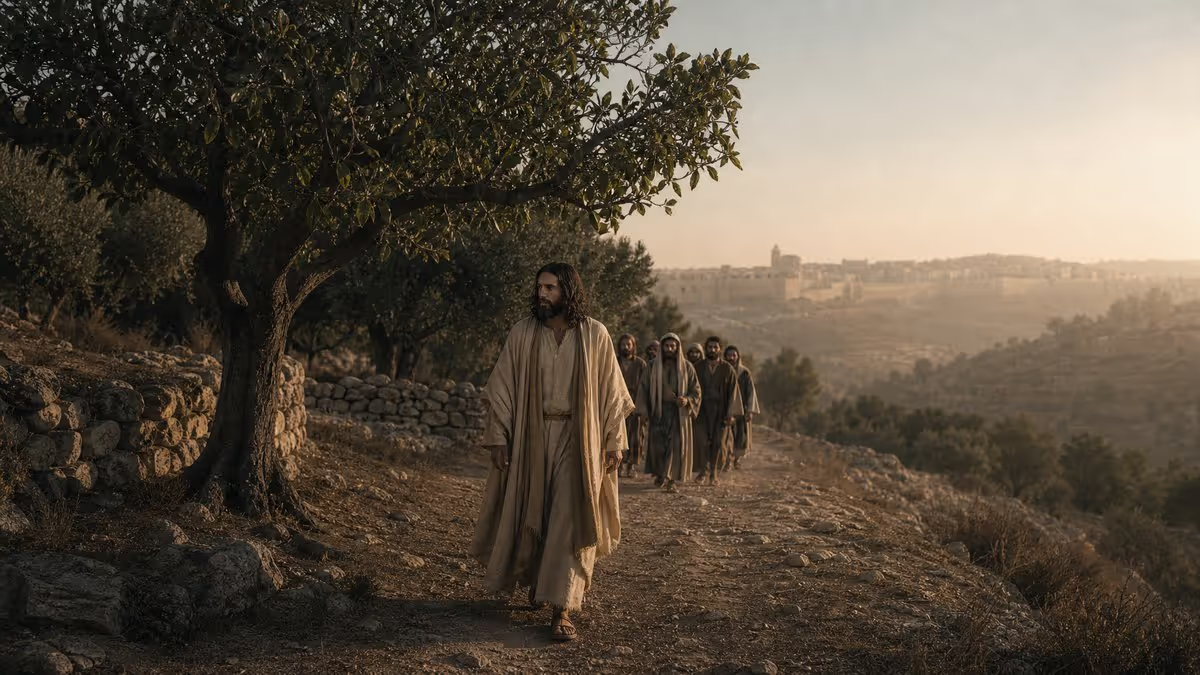
On the Monday morning of the last week of His life, walking in from Bethany with the Twelve, Jesus came to a fig tree covered in leaves. He was hungry. He went looking for fruit, and found none.
Then He spoke to it.
And seeing a fig tree afar off having leaves, he came, if haply he might find any thing thereon: and when he came to it, he found nothing but leaves; for the time of figs was not yet.
And Jesus answered and said unto it, No man eat fruit of thee hereafter for ever. And his disciples heard it.
Why curse a tree for not doing what trees cannot help but do? Why make it a permanent judgment, spoken out loud, in front of witnesses?
He was not a hungry man losing His temper at a tree
The hunger was real. Mark says so plainly. But a hungry man who loses his temper grabs a stick or a stone and moves on. He does not pronounce a permanent sentence on a tree's fruit for life, and he does not do it where his disciples can hear every word.
"And his disciples heard it." Mark puts that detail in for a reason. This was not muttered under His breath. It was said to be remembered.
He had already spent the evening before walking the temple courts, watching. "And Jesus entered into Jerusalem, and into the temple: and when he had looked round about upon all things, and now the eventide was come, he went out unto Bethany with the twelve" (Mark 11:11). He was not surprised by what He found the next morning.
This was the kind of thing prophets did. Isaiah walked barefoot through the streets for three years as a sign of coming exile (Isaiah 20:2-3). Ezekiel built a model siege of Jerusalem out of a clay tile and lay on his side in front of it, and God told him why: "This shall be a sign to the house of Israel" (Ezekiel 4:3). A prophet with a message sometimes acts it out instead of only saying it. Jesus, in the last week before His death, was doing the same thing with a tree.
The tree had leaves and no fruit, and in Israel that was a nation's own picture
A fig tree puts out its fruit with or before its leaves. A tree in full leaf is a tree advertising figs. "For the time of figs was not yet" does not excuse the tree; it names the season for gathering the crop, not a defense for a tree with nothing on it at all. This tree was not early. It was empty.
And in Israel, the fig tree was already a familiar word for the nation itself. God remembered His people's early promise this way: "I found Israel like grapes in the wilderness; I saw your fathers as the firstripe in the fig tree at her first time" (Hosea 9:10). When judgment fell, the prophets used the same picture in reverse:
I will surely consume them, saith the Lord: there shall be no grapes on the vine, nor figs on the fig tree, and the leaf shall fade; and the things that I have given them shall pass away from them.
Jesus had already told this exact story as a parable, months earlier, on the road to Jerusalem: a man planting a fig tree in his vineyard, three years of looking for fruit and finding none, and one more year of mercy before the axe.
Then said he unto the dresser of his vineyard, Behold, these three years I come seeking fruit on this fig tree, and find none: cut it down; why cumbereth it the ground?
A leafy tree with no fruit was not a random victim. It was Israel's own image, walking distance from Jerusalem, on the morning He came looking.
Mark put the temple between the curse and the withering because the two belong together
Mark does not tell the fig tree story straight through. He curses the tree, then walks with Jesus into the temple, then comes back to the tree the next morning already dead. That is not disorder. It is the point.
Because the same morning He cursed the tree, He walked into the temple and did the only destructive act recorded of Him in the Gospels.
And he taught, saying unto them, Is it not written, My house shall be called of all nations the house of prayer? but ye have made it a den of thieves.
A house built for prayer had become a marketplace. A tree built to bear figs had nothing but leaves. Same errand, same week, same verdict. He came seeking fruit and found leaves where there should have been prayer. What the tree announced without a word, the temple heard from His own mouth.
The next morning the tree was dead from the roots, and Jesus turned it into a lesson on faith and prayer
And in the morning, as they passed by, they saw the fig tree dried up from the roots.
Peter pointed at it. "Master, behold, the fig tree which thou cursedst is withered away" (Mark 11:21). And Jesus did not talk about the tree at all.
And Jesus answering saith unto them, Have faith in God.
He spoke of a mountain moved into the sea by a believing prayer, and of asking without doubting. And then, in Mark alone, He attached something to that promise that word-of-faith preaching leaves out:
And when ye stand praying, forgive, if ye have ought against any: that your Father also which is in heaven may forgive you your trespasses.
The withered tree was the object lesson, not the lesson itself. A dead fig tree by the road proved that His word does not fail. What He wanted His disciples carrying away from it was faith joined to forgiveness, not a technique for getting what they wanted.
Where sincere Christians differ
How tightly the tree is tied to national Israel is read two ways. Most readers hold it as a sign to that generation and its leaders. Others read it more broadly, as a warning to any professing believer whose life is leaves with no fruit. Both readings sit inside the text; Jesus Himself turns the lesson toward His disciples, not toward Jerusalem, when He speaks of faith and prayer.
What Mark 11:24 promises is read two ways as well. Some take "what things soever ye desire, when ye pray, believe that ye receive them, and ye shall have them" as a guarantee that confident words secure whatever is named. Read beside the rest of Scripture, the promise is bounded by God's will and by abiding in Christ. We hold that view, and hold it large: God really does hear and answer, and nothing is too hard for Him.
Whether the withered tree means God is finished with Israel is not left open by the wider Bible. The judgment on that generation was real, and it fell, just as Jesus had already wept and warned it would (Luke 19:41-44). But the same prophets who pronounce the judgment also promise a replanting: "I will set mine eyes upon them for good, and I will bring them again to this land: and I will build them, and not pull them down" (Jeremiah 24:6). We hold Israel distinct from the Church and still under God's covenant promises.
So why did Jesus curse the fig tree?
Not because He was hungry and out of patience. Not because a tree broke a rule it could not have kept. Because a nation was doing exactly what that tree was doing. Wearing the leaves of religion. Carrying none of the fruit. "Having a form of godliness, but denying the power thereof" (2 Timothy 3:5).
He had already wept over the city for it (Luke 19:41). He had already told the parable of it (Luke 13:6-9). Now He made a tree preach it in one morning, dead from the roots by the next.
And even then, He did not end on judgment. The same God who judges the leaves without fruit is the God who replants.
What does your life have on it besides leaves? Ask Him, and let Him show you.
Continue the Story
Scripture
What is the parable of the sower?
Jesus told one story about seed and soil to explain why the same gospel produces four different responses in four different hearts.
Scripture
What Is the Lord's Prayer?
Jesus gave His disciples six short petitions as a pattern for prayer. Here is what each one actually asks for.