
People of the Bible
Who Was Orpah?
Orpah was a Moabite widow, daughter-in-law of Naomi, who chose to remain in Moab rather than follow Naomi to Bethlehem, while her sister-in-law Ruth went with her.
A Fork in the Road
Orpah is one of the Bible's quiet figures—a woman whose story is told in only a few verses, yet her choice echoes through the ages. She was a Moabite widow who faced a heart-wrenching decision and, in the end, turned back to her homeland while her sister-in-law Ruth pressed on to Bethlehem.
A Moabite Daughter-in-Law
Orpah lived during the time of the judges, when Israel was ruled by tribal leaders and "every man did that which was right in his own eyes" (Judges 21:25). She was from Moab, a nation east of the Dead Sea, and she became the wife of Chilion, one of the two sons of Elimelech and Naomi. When famine struck Bethlehem, Elimelech took his family to Moab, and there his sons married Orpah and Ruth. After about ten years, Elimelech and both sons died, leaving Naomi and her two daughters-in-law as widows (Ruth 1:1-5).
The Defining Choice
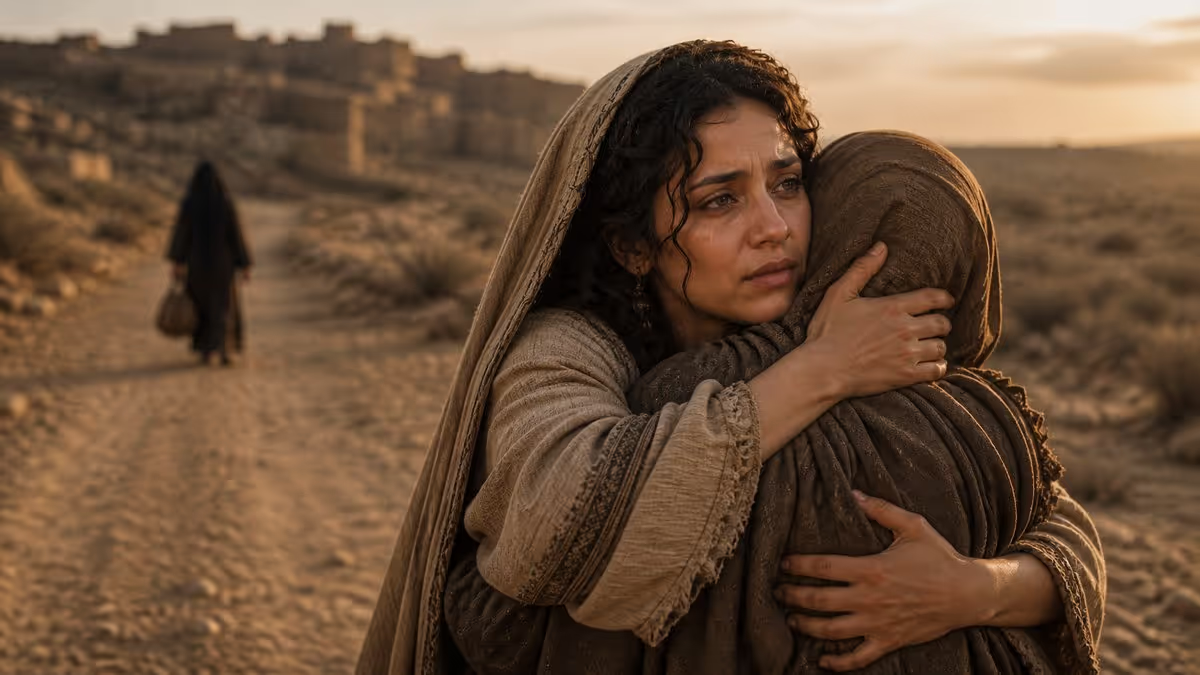
When Naomi heard that the famine in Judah had ended, she set out to return to Bethlehem and urged Orpah and Ruth to go back to their mothers' houses. She blessed them and prayed they would find new husbands. At first, both women wept and insisted on going with her. But Naomi pressed them, reminding them that she had no more sons to offer. Then Orpah made her choice: she kissed her mother-in-law goodbye and returned to her people and her gods (Ruth 1:6-14). Ruth, however, clung to Naomi and pledged to follow her and to worship the LORD.
Scripture does not condemn Orpah. Her decision was understandable—she chose the familiar over the unknown. Yet her story stands in contrast to Ruth's brave faith. Orpah fades from the biblical record, while Ruth becomes the great-grandmother of King David and an ancestor of Jesus (Ruth 4:13-17; Matthew 1:5).
Key Verses
"And they lifted up their voice, and wept again: and Orpah kissed her mother in law; but Ruth clave unto her." (Ruth 1:14, KJV)
"And she said, Behold, thy sister in law is gone back unto her people, and unto her gods: return thou after thy sister in law." (Ruth 1:15, KJV)
Why Orpah Matters
Orpah reminds us that faith often requires a costly step into the unknown. She chose the safe path, and there is no record that she ever encountered the God of Israel again. Her story challenges us to examine our own loyalties: when following God means leaving behind what is familiar, will we cling to Him or turn back? Orpah's brief appearance also shows that God's story includes those on the edges—even those who do not become heroes of the faith.
A Closing Thought
Orpah's life invites us to consider the forks in our own roads. May we, like Ruth, choose the journey of faith, even when it leads away from home.
Continue the Story

People of the Bible
Who Was Caesar Augustus?
Caesar Augustus was the first Roman emperor whose decree brought Mary and Joseph to Bethlehem, fulfilling prophecy.

People of the Bible
Who Was Gabriel?
Gabriel is the angel who stands in the presence of God and delivered the announcements of John the Baptist's and Jesus's births.