
Church & History
Do I Have to Go to Church to Be a Christian?
Short Answer
You are not saved by attendance. But the New Testament has no category for a Christian who belongs to no congregation. Scripture describes believers as parts of one body, commands them not to abandon meeting together, and assumes a life shared with other Christians rather than practised alone.
Usually the honest version of this question is not about theology.
It is about a church that hurt someone, or a Sunday that feels like an obligation.
So take the doctrine first and the ache second.
Attendance does not save anyone.
Let that be said plainly, because some people need to hear it before they can hear anything else.
You are not saved by a building, a membership roll, or a record of Sundays.
Salvation is by grace through faith in Christ, and a person who has never once sat in a service can be fully His.
Nothing that follows is a bill being handed to you.
But the New Testament has no solitary Christians.
Search for one and you will not find it.
Every letter is written to a congregation or to someone leading one.
Paul's basic picture of a believer is a body part.
For as the body is one, and hath many members, and all the members of that one body, being many, are one body: so also is Christ.
A hand is not less valuable detached. It is dead.
The metaphor is not decorative. It assumes you are joined to people.
Scripture gives a direct command about it.
And it names the drift by name.
And let us consider one another to provoke unto love and to good works: Not forsaking the assembling of ourselves together, as the manner of some is; but exhorting one another: and so much the more, as ye see the day approaching.
Two things are worth noticing there.
It was already happening — as the manner of some is. Drifting out of church is not a modern invention.
And the reason given is other people. Consider one another. Provoke one another. Exhort one another.
You cannot do any of that alone, and none of it can be done to you alone.
What the first Christians actually did.
The description is short and concrete.
And they continued stedfastly in the apostles’ doctrine and fellowship, and in breaking of bread, and in prayers.
Teaching. Shared life. The Lord's table. Prayer.
None of those four is a solo activity. Three of them are impossible by yourself.
What you lose by staying away.
Not points with God. Something more practical.
You lose people who will tell you the truth when you are wrong.
You lose the pressure of being known, which is the only thing that reliably grows anyone.
You lose the chance to be useful to someone who needs what you have.
For the perfecting of the saints, for the work of the ministry, for the edifying of the body of Christ: Till we all come in the unity of the faith…
God's plan for maturing you runs through other Christians. Opting out of them is opting out of that.
If church is where you were hurt.
Then this is not a lecture aimed at you.
Churches have covered up abuse, protected the powerful, and driven out the people they were meant to protect.
That is real, it is evil, and Scripture is harder on it than any critic has ever been.
Leaving a congregation like that can be the faithful thing to do.
But the answer to a bad church is a good one, not none — and finding one may take longer than you want it to.
So do you have to go to church to be a Christian?
You do not have to go to church to be saved.
You do have to be joined to God's people to live the life Scripture describes.
Not as a fee. As the place it happens.
Christ did not die for a crowd of individuals. He died for a body, and you are meant to be part of it.
Bottom line
No one is saved by attending a service. But Scripture knows nothing of a solitary Christian: believers are members of a body, commanded to keep meeting, and grown through people they did not choose. Church is not the price of salvation. It is where the saved live.
Continue Exploring
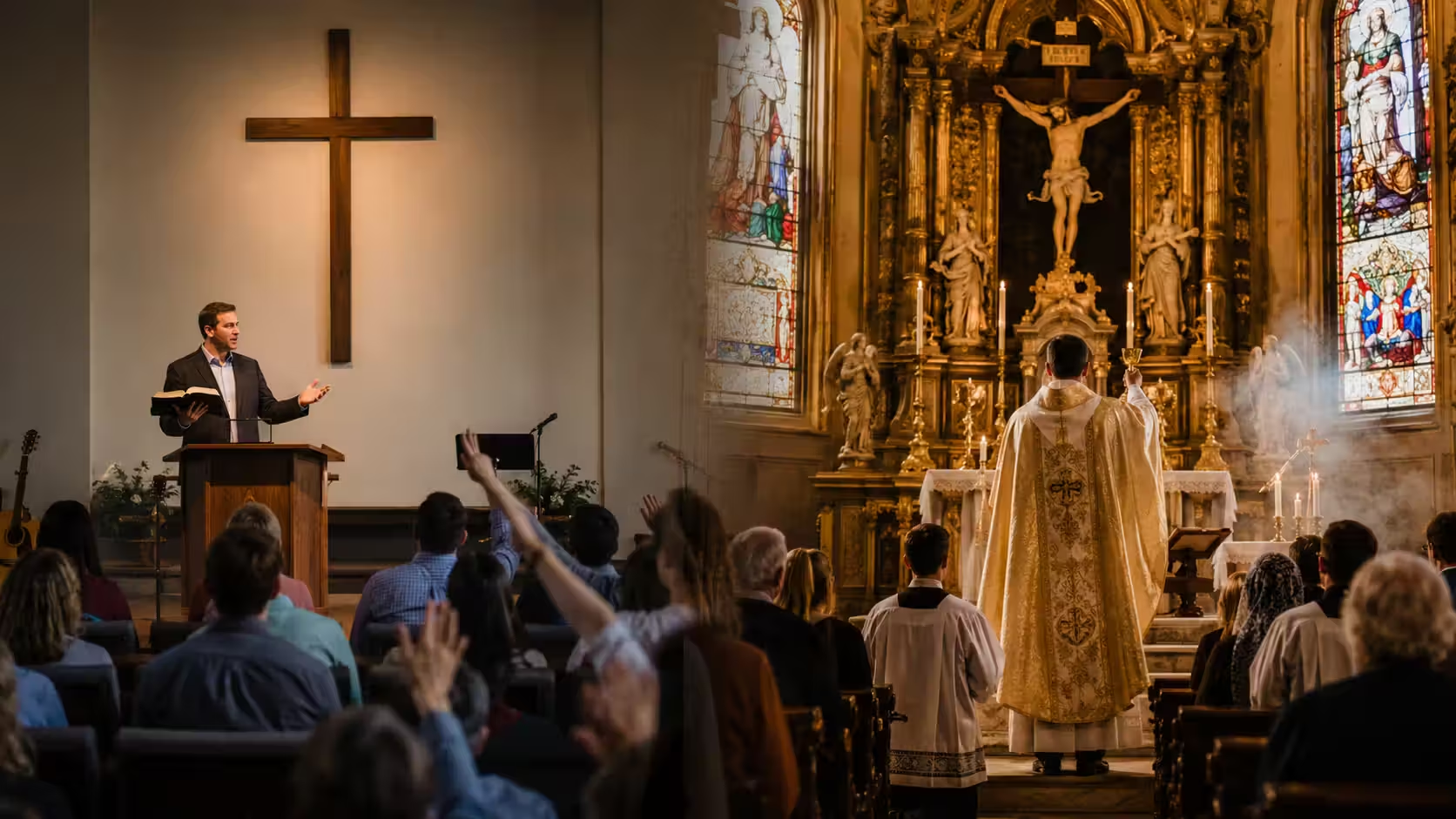
- Church & HistoryWhat is the difference between Catholic and Protestant?The central difference is authority. Protestants hold to sola scriptura—Scripture alone is the final authority for faith and practice. The Catholic Church teaches that Scripture and church tradition, interpreted by the teaching office (magisterium) under the Pope, together carry authority. From this root flow other differences: salvation by faith alone versus faith plus sacraments, the role of Mary and the saints, purgatory, and the nature of the Lord’s Supper.Read answer →
- Faith & SalvationWhy is Jesus the only way to God?Jesus is the only way to God because sin has separated every person from a holy God, and only Jesus can bridge that gap. He alone is fully God and fully man, the one mediator able to offer a perfect, sinless sacrifice. No amount of good works, sincerity, or religion can reconcile a guilty sinner to God. Jesus said, “I am the way, the truth, and the life: no man cometh unto the Father, but by me” (John 14:6).Read answer →
- Prophecy & End TimesWhat does the Bible say about Israel?The Bible presents Israel as God’s chosen nation—a people He called through Abraham, delivered from Egypt, and gave the land of Canaan. God made an unconditional covenant with them, and though they were scattered for disobedience, the prophets promised a future restoration. Paul insists God has not cast away His people. In this reading, the church and Israel are distinct, and God’s promises to Israel will be literally fulfilled.Read answer →

Still have a question?
Send it in and we will research it and write an answer.