
People of the Bible
The Story of David and Goliath: Faith That Faces Giants
The story of David and Goliath is one of the most famous confrontations in human history — not just in the Bible, but in all of literature. It's the archetypal underdog story.

The story of David and Goliath is one of the most famous confrontations in human history — not just in the Bible, but in all of literature. It's the archetypal underdog story. A young shepherd boy, armed with a sling and five smooth stones, stands against a battle-hardened giant nearly ten feet tall. The outcome defies every military calculation.
But the story of David and Goliath isn't really about a sling and a stone. It's about the kind of faith that sees something the crowd cannot see.
The Setting: Israel and the Philistines at War
The confrontation takes place in 1 Samuel 17, during the reign of King Saul. The Israelite army and the Philistine army are camped on opposite sides of the valley of Elah, a strategic pass in the Judean foothills.
Every morning and evening for forty days, the Philistines send out their champion — a man named Goliath from the city of Gath. The text gives his dimensions precisely: he stood six cubits and a span tall (roughly 9 feet 9 inches by traditional measurement, though some manuscripts suggest 6 feet 9 inches). He wore a bronze helmet and a coat of armor weighing 125 pounds. His spear's iron tip alone weighed 15 pounds.
His challenge was simple: send out a champion to fight me one-on-one. If your man wins, we'll be your subjects. If I win, you'll serve us.
The Israelite army was terrified. "When the Israelites saw the man, they all fled from him in great fear" (1 Samuel 17:24). For forty days, no one accepted the challenge.
David Arrives
David was the youngest of Jesse's eight sons, too young to serve in the army. He was back home tending the sheep. Jesse sent him to the battlefront to bring food to his three oldest brothers and check on their welfare.
When David arrived, he heard Goliath's challenge. He heard the soldiers talking about the reward Saul had promised to anyone who killed the giant — riches, the king's daughter in marriage, and exemption from taxes.
But what David focused on wasn't the reward. It was the insult.
"Who is this uncircumcised Philistine that he should defy the armies of the living God?" David asked (1 Samuel 17:26).
His oldest brother Eliab was furious at this. "I know how conceited you are and how wicked your heart is," he snapped. "You came down only to watch the battle."
David ignored him and kept asking. Word of this fearless young shepherd reached King Saul, who summoned David.
David Before Saul
Saul tried to talk David out of it. "You are not able to go out against this Philistine and fight him," he said. "You are only a young man, and he has been a warrior from his youth" (1 Samuel 17:33).
David's response reveals everything about his character. He didn't appeal to courage or skill. He appealed to a track record of divine help.
"Your servant has been keeping his father's sheep. When a lion or a bear came and carried off a sheep from the flock, I went after it, struck it and rescued the sheep from its mouth... Your servant has killed both the lion and the bear; this uncircumcised Philistine will be like one of them, because he has defied the armies of the living God" (1 Samuel 17:34–36).
This was not bravado. It was theology. David's confidence wasn't in himself — it was in the God who had shown up in the wilderness with the sheep.
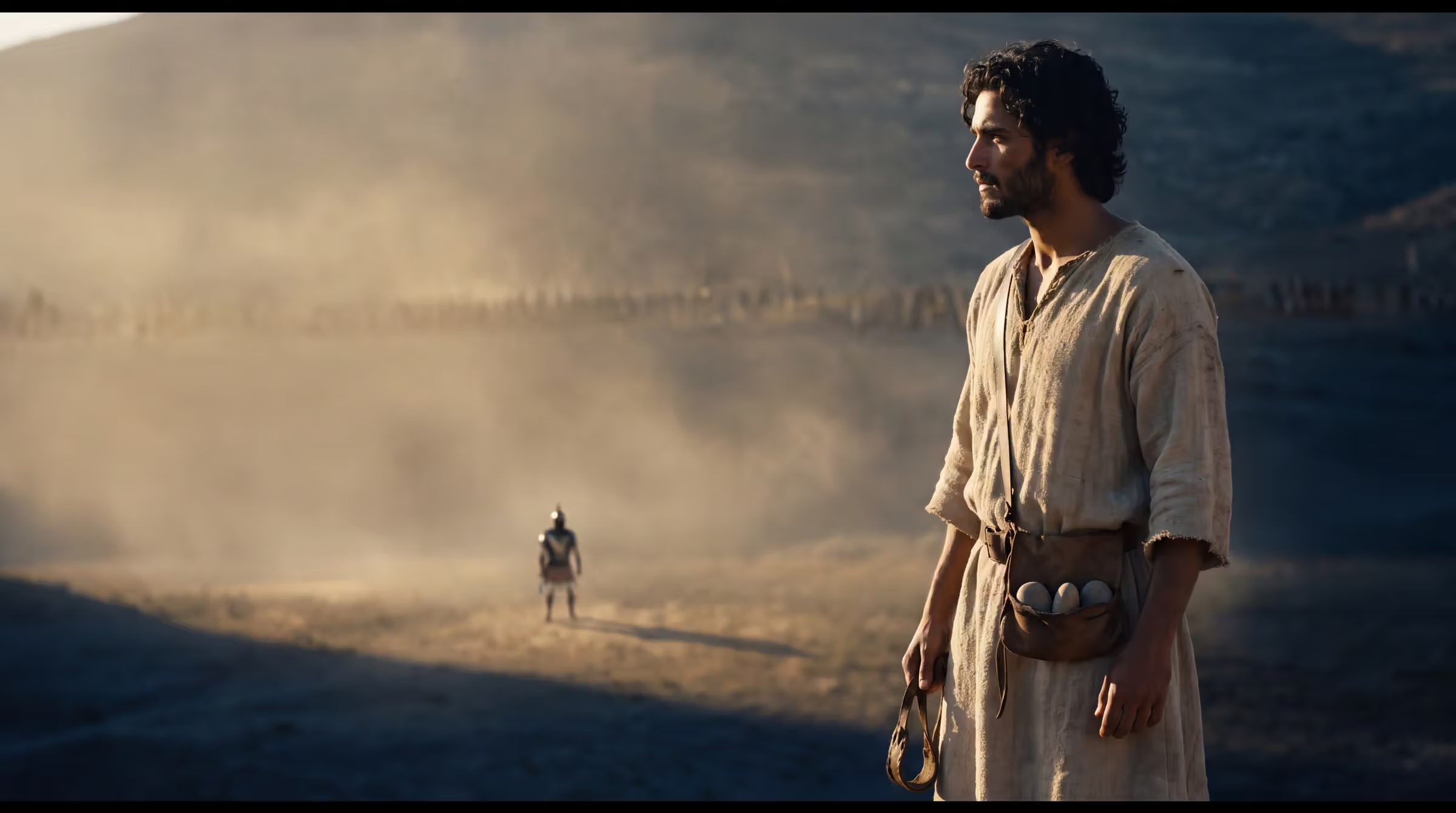
Saul agreed to let him go, and tried to arm him with his own armor. David put it on, but it didn't fit. He wasn't a soldier. He took it off, picked up his shepherd's staff, chose five smooth stones from a stream, and walked toward the giant with his sling in his hand.
The Battle
Goliath looked at David and was offended. "Am I a dog, that you come at me with sticks?" He cursed David by his gods and threatened to feed his flesh to the birds.
David's reply is one of the most famous speeches in Scripture:
"You come against me with sword and spear and javelin, but I come against you in the name of the LORD Almighty, the God of the armies of Israel, whom you have defied. This day the LORD will deliver you into my hands... and the whole world will know that there is a God in Israel. All those gathered here will know that it is not by sword or spear that the LORD saves; for the battle is the LORD's, and he will give all of you into our hands" (1 Samuel 17:45–47).
David ran toward Goliath. He reached into his bag, took out a stone, and slung it. The stone struck Goliath in the forehead. The giant fell face down on the ground. David stood over him, drew Goliath's own sword, and cut off his head.
The Philistines fled. The Israelite army pursued them.
What the David and Goliath Story Means
The story of David and Goliath is about perspective. Everyone else saw Goliath as too big to fight. David saw him as too big to miss.
That difference in perspective came from David's relationship with God. He had seen God show up in the lonely places — while tending sheep, facing lions and bears with no one watching. He knew what God was capable of.
Faith isn't the absence of fear. It's the presence of a bigger reality.
The New Testament picks up this theme throughout. Paul writes in 2 Corinthians 10:4 that "the weapons we fight with are not the weapons of the world." David understood this long before Paul put it into words.
What Goliath-sized challenge are you facing today? The story of David and Goliath asks us where we are looking — and who we are trusting.
Explore David's Full Story at The Ark Life Bible Directory
David's confrontation with Goliath was just the beginning. He went on to become Israel's greatest king, a poet and musician, a man after God's own heart who failed profoundly and returned to God genuinely.
Explore the full arc of David's life and dozens of other Bible characters at livethearklife.com.
Continue the Story
People of the Bible
Who Was Omri?
Omri was a powerful but wicked king of Israel who built Samaria and led the nation into idolatry, setting the stage for disaster.
People of the Bible
Who Was Asher?
Asher, the eighth son of Jacob, received a blessing of rich food and royal delicacies, symbolizing a life of contentment and God's faithful provision.