Scripture
What Is the Day of Atonement?
Once a year a man walked behind a curtain alone, with blood, and no one else was allowed near him. Here is why, and why you no longer have to.
Once a year, one man in Israel walked through a curtain that nobody else was allowed to touch.
He went in alone. He went in with blood. If he got something wrong in there, he did not come back out.
Why did God set it up that way?
God opened one door, and he opened it only once a year.
Leviticus 16 does not open with instructions. It opens with a funeral.
And Nadab and Abihu, the sons of Aaron, took either of them his censer, and put fire therein, and put incense thereon, and offered strange fire before the Lord, which he commanded them not. And there went out fire from the Lord, and devoured them, and they died before the Lord.
Nadab and Abihu were Aaron's own sons. They offered fire God had not commanded, and fire came out from the Lord and killed them where they stood.
That is the sentence the whole chapter is written under. So when God tells Aaron how he may come near, he states the warning before he states the mercy.
And the Lord said unto Moses, Speak unto Aaron thy brother, that he come not at all times into the holy place within the vail before the mercy seat, which is upon the ark; that he die not: for I will appear in the cloud upon the mercy seat.
One man. One day. One door.
Not a technique anyone could learn. Not a right anyone could claim.
The day itself was fixed on the calendar too, the tenth day of the seventh month, a sabbath, a day to afflict the soul, "a statute for ever" (Leviticus 16:29, 31).
The blood had to cross the veil, and it had to land on the mercy seat.
Getting in was not the hard part. Staying alive once he was in there was.
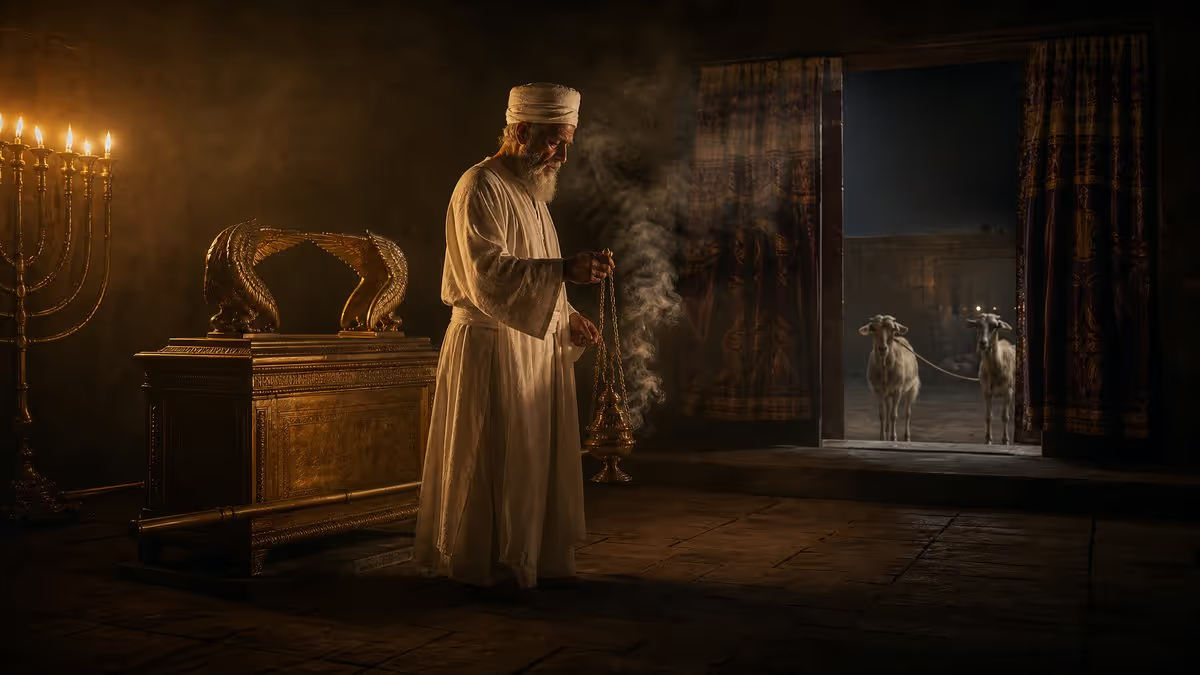
Aaron did not wear his gold priestly garments for this. He wore plain white linen, like a penitent man rather than a dignitary.
Incense went first, so smoke would cover the seat.
And he shall put the incense upon the fire before the Lord, that the cloud of the incense may cover the mercy seat that is upon the testimony, that he die not:
Then the blood. The bull's blood for himself and his house, the goat's blood for the people, carried past the veil and put where no hand but his was permitted to reach.
And he shall take of the blood of the bullock, and sprinkle it with his finger upon the mercy seat eastward; and before the mercy seat shall he sprinkle of the blood with his finger seven times.
An atonement had to be made for the holy place itself, "because of the uncleanness of the children of Israel" (Leviticus 16:16). Sin had reached the meeting place, not only the people.
Leviticus gives the reason blood, and only blood, could reach it.
For the life of the flesh is in the blood: and I have given it to you upon the altar to make an atonement for your souls: for it is the blood that maketh an atonement for the soul.
Substitution, not sentiment. The animal died in the place of the one who sinned, and its blood paid for that life.
Two goats carried two halves of the same problem.
Two goats stood at the door of the tabernacle, and Leviticus calls both of them, together, one sin offering. Lots decided which did what.
And Aaron shall cast lots upon the two goats; one lot for the Lord, and the other lot for the scapegoat.
The first goat died. Its blood went in past the veil, exactly like the bull's.
The second goat was never killed. It was brought alive before Aaron, who laid both his hands on its head.
And Aaron shall lay both his hands upon the head of the live goat, and confess over him all the iniquities of the children of Israel, and all their transgressions in all their sins, putting them upon the head of the goat, and shall send him away by the hand of a fit man into the wilderness: And the goat shall bear upon him all their iniquities unto a land not inhabited: and he shall let go the goat in the wilderness.
Guilt was paid by one goat's death. The stain was carried away by the other goat's life.
The lot for the second goat fell "for the scapegoat," a translation of a Hebrew word, Azazel, whose exact meaning scholars still argue over. The text says only that the goat went out alive, bearing iniquity, into a land not inhabited.
Preach only the dying goat and you have payment without removal. Preach only the live goat and you have removal without payment. Leviticus 16 insists on both.
Hebrews says the whole day was a shadow, and the shadow has an owner.
The writer of Hebrews looked back at all of this and gave it a name: a shadow.
But into the second went the high priest alone once every year, not without blood, which he offered for himself, and for the errors of the people: The Holy Ghost this signifying, that the way into the holiest of all was not yet made manifest, while as the first tabernacle was yet standing:
Once a year. Not without blood. The way in was not yet open.
Then Hebrews turns the argument on two words.
Neither by the blood of goats and calves, but by his own blood he entered in once into the holy place, having obtained eternal redemption for us.
Not the blood of goats and calves, but his own. Not a copy of the sanctuary, but heaven itself (Hebrews 9:24). Not every year, but once: ephapax, a Greek word meaning once for all.
Hebrews is blunt about what the animal blood could never do.
For it is not possible that the blood of bulls and of goats should take away sins.
That is why the day came back every year. Each repetition was a confession that the blood had not yet reached what blood is finally for: the conscience. It covered. It did not cleanse.
Where sincere Christians differ
Are the biblical feasts, Yom Kippur included, still binding on believers? Some Torah-observant and Hebrew Roots teachers hold that they are. Most Bible-believing churches hold that the shadow has met its substance in Christ and that the Church is not under Sinai's calendar. We hold the second. Hebrews calls these sacrifices "a shadow of good things to come" (Hebrews 10:1) that Christ has already fulfilled. The day is Scripture, and it still teaches. It is not a duty we owe.
What does the live goat picture? Many read both goats as Christ, who died for sin and who also carries it away (Hebrews 9:28). Others, especially in dispensational teaching, read the live goat as the enemy bound and removed in the coming kingdom. Scripture does not settle it, so we will not either.
So what is the Day of Atonement to you?
Not a date you owe God.
Not a fast to keep.
A door.
The curtain that shut out everyone but one man, one day a year, tore the moment Jesus died.
And, behold, the veil of the temple was rent in twain from the top to the bottom; and the earth did quake, and the rocks rent;
Top to bottom. God's side of the curtain, not man's.
Having therefore, brethren, boldness to enter into the holiest by the blood of Jesus, By a new and living way, which he hath consecrated for us, through the veil, that is to say, his flesh;
A way in. Blood that never needs to be offered twice. A veil that does not have to be crossed by anyone else, ever again, because it is already torn.
Israel's high priest acted this out once a year, in fear, alone.
You already have what he could only act out.
Have you walked through that door? You do not need incense, linen, or a fit man to lead anything away. You need to trust the one whose blood already opened the way.
Continue the Story
Scripture
What does Psalm 23 mean?
Most people have heard Psalm 23 read at a funeral. Few have been shown what it actually says, verse by verse.
Scripture
What happened at the Tower of Babel, and why does it matter?
Babel was never about how tall the tower was. It was about a name men grabbed for themselves, instead of the name God gives.