Biblical World Tracker

Tel Dan Stele

Credibility: Confirmed

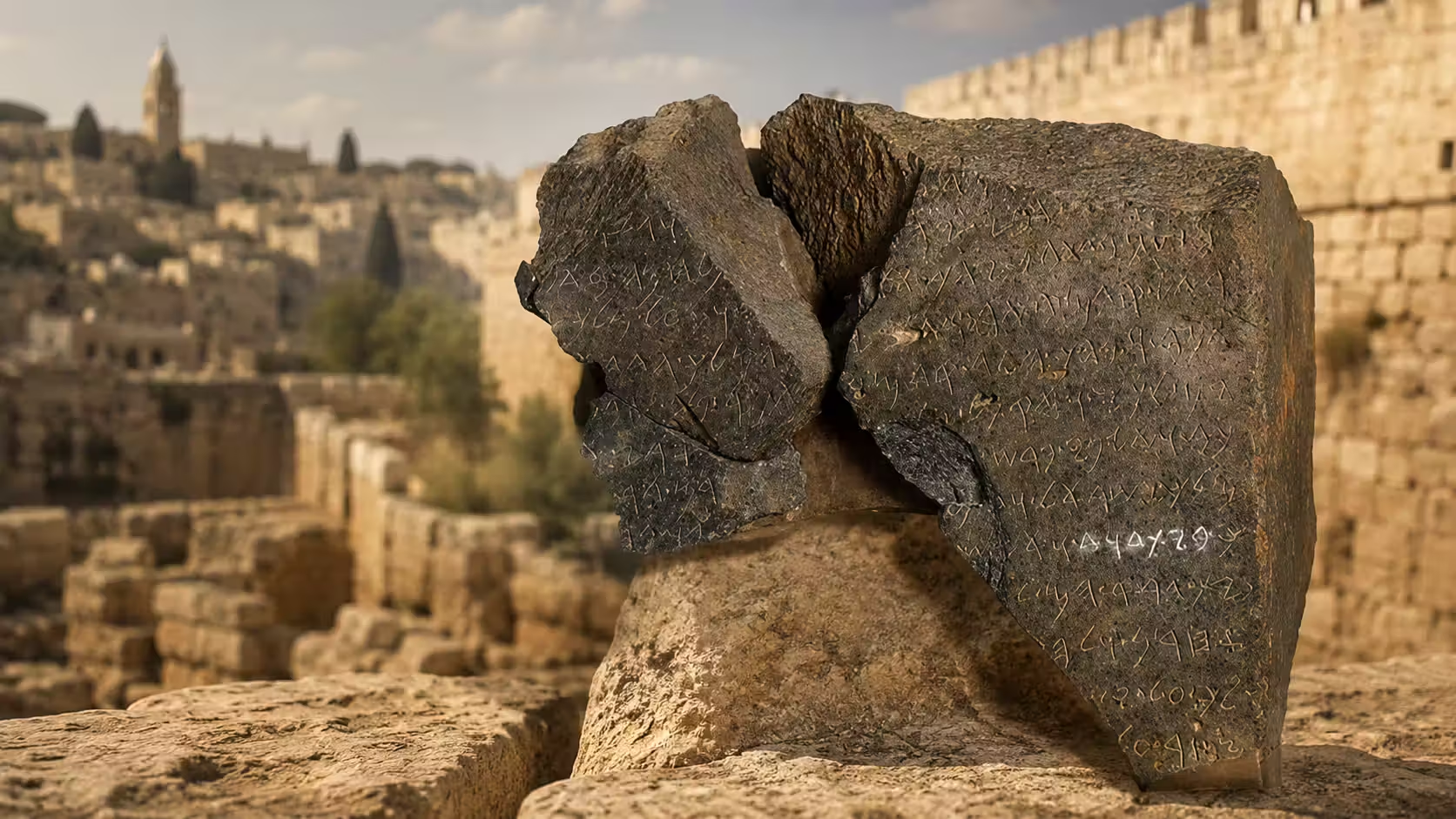
A 9th-century BCE Aramaic victory inscription fragment unearthed at Tel Dan in northern Israel. It contains the earliest known extra-biblical reference to the 'House of David' (בית דוד), confirming King David's dynasty as a historical entity recognized by neighboring kingdoms within roughly 150 years of his reign.

Published in Israel Exploration Journal (1993, 1995), examined by multiple independent epigraphers, and broadly accepted by the scholarly field. The 'House of David' reading — once disputed by a minority of minimalists — is now nearly universally recognized.

Find
Inscription
Place
Tel Dan, Israel, Upper Galilee
Period
c. 840 BCE
Announced
August 1993

Discovery

The Tel Dan Stele was discovered in 1993–1994 during excavations led by Avraham Biran at Tel Dan in the upper Galilee of northern Israel. Fragment A was found in July 1993 reused as building material in a wall; two additional fragments (B1 and B2) were recovered the following year.

The Inscription

Written in Old Aramaic on basalt, the stele was erected by Hazael, king of Aram-Damascus (or possibly his son), to commemorate a military victory over Israel. The surviving text boasts of killing '[Jeho]ram son of [Ahab] king of Israel' and '[Ahaz]iah son of [Jehoram] king of the House of David.'

Significance

The phrase 'House of David' (beit Dawid) is the headline — it is the earliest extra-biblical reference to King David ever found, dating to within about 150 years of David's lifetime. Before this stele, some minimalist scholars argued David was a mythical figure. The stele shows that by the mid-9th century BCE, the Davidic dynasty was well enough established that a foreign king named Judah by its founder.

Biblical Connection

The stele describes Hazael killing both the king of Israel and the king of Judah — the same two kings (Jehoram of Israel and Ahaziah of Judah) whose deaths are recounted in 2 Kings 9. The biblical text attributes their deaths to Jehu's revolt, not Hazael directly, creating a fascinating point of contact and tension between the two accounts. Both sources agree that both kings died in the same period, around 841 BCE.

In Scripture

Sources

More from the tracker

All entries
  • Credibility: Confirmed

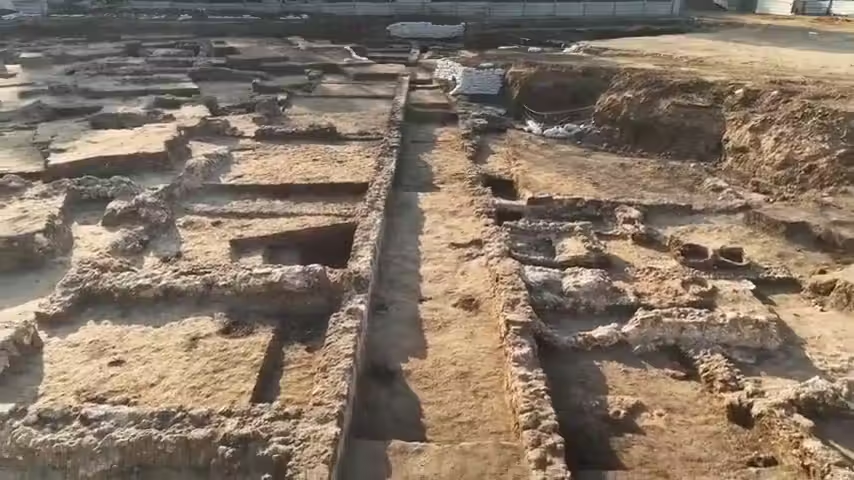
    1,300-year-old industrial hub uncovered during bus terminal construction in Ramat Gan

    A salvage excavation conducted before construction of a new bus terminal uncovered a planned industrial and commercial district beneath the parking lot of Winter Stadium in Ramat Gan. The complex contained intersecting streets, shops, warehouses, pottery kilns, liquid-production installations, lamps, coins, tools, and other objects. It operated mainly during the early Islamic period and was later reused for housing.

    Jaffa—biblical Joppa—with Jerusalem7th - 9th Centuries ADSite

  • Credibility: Confirmed

    Urartu’s Inscribed Bronze Bowls

    A new study of over 100 inscribed bronze bowls from the ancient kingdom of Urartu (biblical Ararat) reveals how Urartian cuneiform evolved and how royal authority was expressed. The bowls, now in museums across Armenia and Russia, show a gradual standardization of script and provide indirect evidence for royal workshops. The study offers fresh insights into a civilization that left few written records.

    Urartu (biblical Ararat), various museum collectionsninth–seventh centuries BCEArtifact

  • Credibility: Claimed

    Seal Impression of Yeda’yah Son of Asayahu Found in Temple Mount Sifting

    A small clay bulla bearing the seal impression of Yeda’yah son of Asayahu was discovered by the Temple Mount Sifting Project. Dating to the late seventh or early sixth century BCE, the bulla may connect to Asaiah, an official mentioned in 2 Kings 22 and 2 Chronicles 20 during King Josiah's reign. While the connection is plausible, it remains uncertain.

    Temple Mount Sifting Project, Jerusalemlate 7th–early 6th century BCEArtifact

A brass compass and pocket watch resting on aged paper

Stay informed. Stay encouraged.

Join the Ark Life Newsletter

Weekly studies, news, and encouragement—straight to your inbox.